
TBM 422: Exception, Presence, Delegation

Side note, I have a live talk up on YouTube that I’m proud of called Single Player to Multiplayer: AI, Context, and Collaboration if watching/listening is more your thing.
Like a lot of leaders and practitioners I talk to, I’m trying to wrap my head around what I see happening in companies right now. The fatigue is real, the pressure is coming from many directions, and it’s impacting people in often very different ways.
I hosted a small TBM meetup in SF recently, and it felt so refreshing to be chatting in person, without the weight of optics, hype, dancing to company norms, and the usual performative composure. One thing that stood out was the mix of optimism and genuine excitement, with an appreciation for things being “not ok” (especially if you’re really paying attention).
I keep coming back to whether existing principles still hold And if so, why they feel so hard to apply right now.
Why do some leaders seem so out of touch with the vibe at the moment? Or is it that they are very “in touch,” and what we’re seeing is a defense mechanism, or even an act of territorial aggression?
AI should mean more flow and less cognitive load. So why does everything feel heavier?
Why is middle management and glue people getting such a bad rap currently? Why are leaders claiming they are so in the dark about what is happening? Why are the normal instincts breaking down? Why are we repudiating the “normal” playbook?
Why, to quote the title of a recent post, are we Seeing Everything, Understanding Nothing?
It has driven me to some “back to basics” thinking. One model I’ve been playing with lately is the triad of Exception, Presence, and Delegation. The ideas aren’t new, but it has sparked some good conversations and thoughts.t
This post:
The three motions and how they interact
Mintzberg’s configurations
Using examples to explore Scaffolding vs. Load-Bearing (Mulally, Chesky, and Huang
Back to those questions
Three Motions
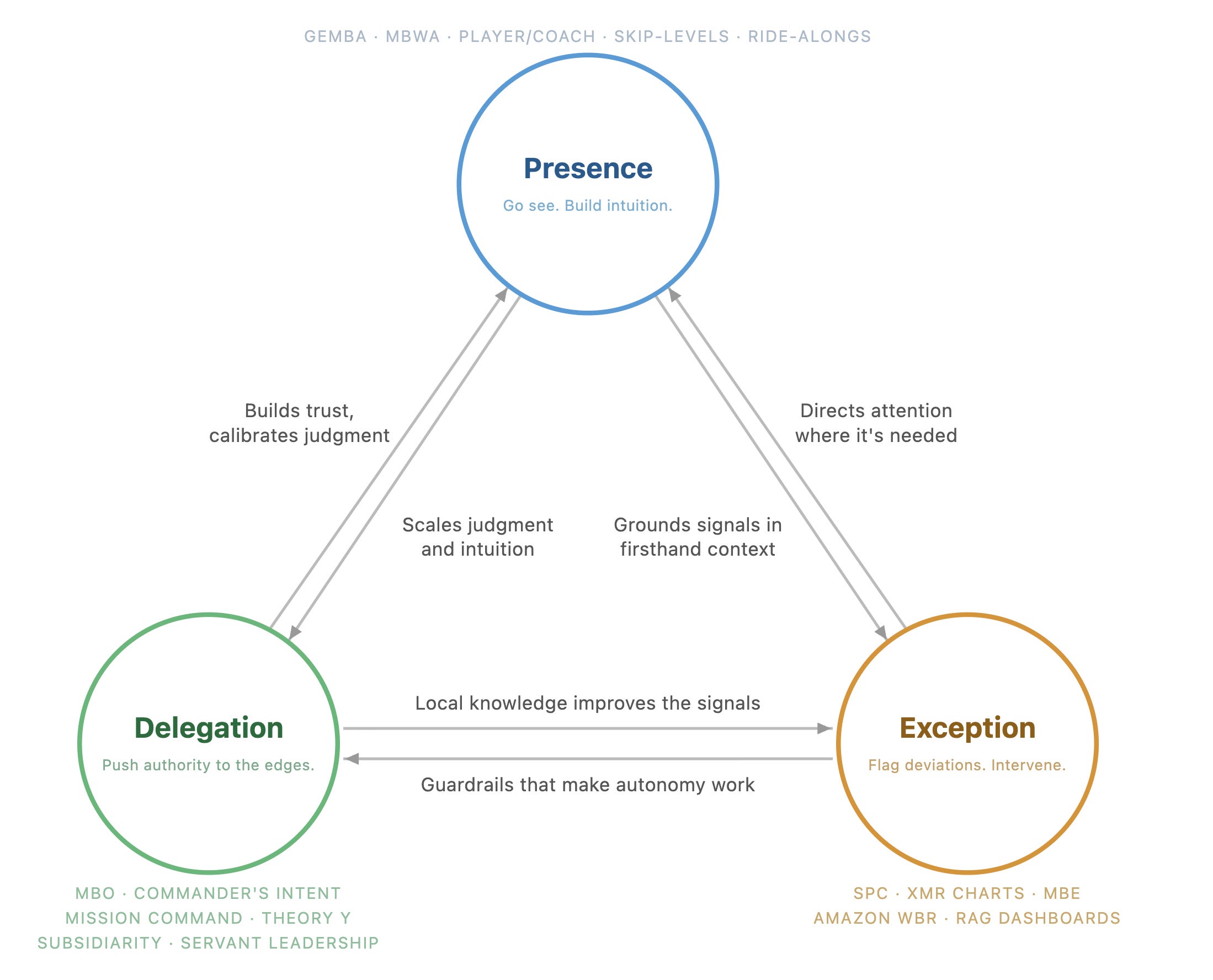
Consider three fundamental motions in management/leadership:
Exception-based
You set up systems to flag when something deviates from what’s expected, and only then do you intervene. Done well, these systems are also how you learn (individually and collectively). As Cedric Chin has written, approaches like Amazon’s WBR build a shared causal model of the business into people’s heads over time, and help them explore and refine that model. The exception system is the learning mechanism. (See: statistical process control (SPC), XMR charts, Amazon’s Weekly Business Review (WBR), RAG dashboards, management by exception (MBE).)
Presence-based
You “go see” (genchi genbutsu) for yourself. You stay close to the work to build firsthand understanding and develop the intuition that no report or dashboard can give you. Presence is also how expert intuition gets transferred. Design critiques, Pixar’s Braintrust, side-by-side pairing, apprenticeship. You can’t write down tacit knowledge. It transfers when people work together on real problems. (See: Gemba walks, management by walking around (MBWA), founder mode (the positive interpretation, not the pathological one), player/coach, skip-level meetings, ride-alongs.)
Delegation-based
You push authority to the people closest to the work. You align on outcomes, then trust them to figure out the how. Or as David Marquet put it after transforming a struggling nuclear submarine: “push authority to information, as opposed to information to authority.” (See: management by objectives (MBO), commander’s intent, Theory Y, subsidiarity, servant leadership, self-organizing teams, mission command.)
These labels are imperfect. “Delegation” hints at prescriptive orders, but it also includes bottom-up self-organization and peer-to-peer alignment. “Exception” hints at mechanistic control, but exceptions can be emergent and intuitive, not just dashboards with thresholds. And “presence” doesn’t necessarily mean in-person. It means synchronous, engaged, intentional attention to the details. The boundaries blur. But the labels are useful enough to work with.
The Virtuous (Or Wicked) Loop
When the three work together, they create a virtuous loop. When they don’t, you see a lot of familiar org-stress anti-patterns.
Exceptions
Exception-based approaches, when they work well, free up time and attention for presence and delegation. Focus goes where it is needed most, and over time, and ideally with coworkers, you build an intuition for what drives (or causes drag) for the business.
Without presence and delegation, the exec says:
We have great data. The dashboards are all there. People just need to use them.
The team says:
We have dashboards for everything, but no one knows what any of it means. When leadership actually looks at them, it triggers a completely random fire drill. No one can connect it to what is actually happening in the technical and product details. Everyone scrambles, but no one has the authority to actually fix anything without three levels of approval.
Trap: Confusing legibility with understanding. The data looks clean from the top, so you forget no one closer to the work helped make sense of it.
Presence
Presence builds the intuition to recognize exceptions and put them in context. Presence also builds credibility (when wielded with humility), along with the relationships, alliances, and shared understanding that make delegation actually work. You can convey guidance, calibrate judgment, and build trust in ways that docs and dashboards can’t. It also builds trust that leaders will act responsibly and skillfully when escalations happen.
Without exceptions and delegation, the exec says:
I need to be in the details. That’s how I add value.
The team says:
Nothing moves unless our VP is in the room. She’s in every meeting, and she’s exhausted, and so are we. We’ve stopped even bothering to think about it ourselves, because our thinking will go to waste.
Trap: Mistaking your own involvement for value creation. The team’s learned helplessness feels like proof they need you.
Delegation
Delegation creates local knowledge (and local presence) that improves exception systems. The people doing the work know which signals matter. You’re not using Nth-time removed RAG charts wrapped in wishful thinking and optics. Presence scales that up, down, and across the org. And delegation, done well (with coaching, back-briefing, and presence), scales everyone’s intuition. It brings other people’s judgment and presence up so the whole system doesn’t depend on one person’s attention.
Without exceptions and presence, the exec says:
We’ve empowered our teams. They have full ownership.
The team says:
They told us to own it, but no one told us what good looks like, and we have no guardrails to tell us if things are working. No one is close enough to the work to give us real feedback, or really understand the challenge. When we try to escalate, by the time it reaches leadership it has been watered down. Not worth it. So every team is doing something different and hoping for the best.
Trap: Treating autonomy as something you announce rather than something you build and nurture. Empowerment without shared context.
Mintzberg’s Configurations
Mintzberg mapped organizational configurations decades ago, and each one basically overweights one of these motions:
Entrepreneurial (Simple Structure): The founder coordinates through direct supervision. All presence. Exceptions and delegation live in one person’s head. Fast and coherent, but the founder becomes the bottleneck.
Machine Bureaucracy: Standardized work processes. Heavy exception-based. Delegation is highly transactional, leaving the front line with prescriptive and narrow mandates. Think assembly lines, compliance-driven industries. Works in stable environments. Breaks in dynamic ones.
Professional Bureaucracy: Standardized skills. Heavy delegation. Trained professionals own the work. Hospitals, law firms, universities. Presence is peer-based. Exceptions are professional judgment.
Divisionalized Form: Standardized outputs. Exception-based at the corporate level (performance metrics). Delegation to division heads. Presence is the quarterly review.
Adhocracy: Mutual adjustment. Closest to the virtuous loop. Small teams, constant recalibration, distributed authority. But fragile and exhausting. Great for innovation, hard to sustain.
Missionary: Standardized norms. Delegation via culture and shared beliefs. Netflix’s “context not control” fits here. Powerful when the culture holds. Brittle when it cracks.
Each configuration flexes in a certain way.
As Mintzberg put it: “Most organizations experience all five of these pulls; however, to the extent that conditions favor one over the others, the organization is drawn to structure itself as one of the configurations.” The shape depends on the context. Organizations use what they need to use, and the mix shifts over time.
Scaffolding vs. Load-Bearing
How does this all play out in companies, and with leaders?
Scaffolding
Some leaders embody all three.
I stumbled on a random YouTube interview with Alan Mulally recently, and the interplay was obvious.
He had 37 years of engineering credibility at Boeing (lead engineer on the 777). That presence meant people took him seriously when he walked in the room at Ford. (This was before Boeing’s well-documented safety crises, which many attribute to drifting away from exactly this kind of culture.)
He introduced a weekly Business Plan Review — green, yellow, red. But the exception system only worked because he was present every week and made it safe to show red. Without that, it was just another watermelon chart.
His “Working Together” philosophy pushed decision-making out to the team. But delegation only worked because everyone was looking at the same signals, in the same room, every week.
Each leg made the other two possible, and his presence was scaffolding.
The goal was to build systems and culture that could hold without him in the room. A caveat: it’s easy to build heroic narratives around turnarounds. Phil Rosenzweig’s The Halo Effect warns that we routinely attribute success to leadership qualities after the fact, working backwards from the outcome. Ford’s stock dropped 40% under Mulally’s own chosen successor. The systems didn’t hold the way the story suggests. Still, the interplay between the three motions is instructive, even if the retrospective narrative is cleaner than the reality.
Founder Mode
Now compare that to the “founder mode” movement. In 2024, Brian Chesky’s approach at Airbnb became a rallying cry for hands-on leadership. The backstory matters.
From 2015 to 2019, Airbnb was in full ZIRP-era expansion mode. Experiences, Plus, Luxe, Trips, transportation, a magazine, restaurant reservations through Resy, a massive push into China. New divisions for every new opportunity. Chesky followed the conventional playbook: hire good people, empower them, get out of the way. “I did all these things everyone told you to do,” he said later, “and the results were devastating.” Fiefdoms formed. Costs rose. Employees worked 80 hours and got 20 hours of productive work. Meetings about meetings about meetings.
From my vantage point, however, the drift wasn’t a failure of delegation.
It was delegation without exceptions or presence. No shared signals. No Schelling points for autonomous groups to coordinate around. Alex Komoroske’s coordination headwind framework explains this well: as organizations scale, coordination costs grow with the square of the number of people involved.
His Schelling point model goes further: when you increase the number of equivalent-looking options (more products, more growth vectors, more parallel bets), coordination actually gets worse, not better. Even with communication, people split across the options. Without a clear shared focal point, the organization fragments. That’s exactly what ZIRP-funded sprawl did. It created a dozen plausible priorities with no shared signal to coordinate around. The slime mold with too many directions and no gradient to follow.
When COVID hit and wiped out 80% of Airbnb’s revenue, the initial response was standard crisis management: hiring freeze, marketing cuts, exec salary cuts. Then in May 2020, Chesky laid off 1,900 people (25% of the company) and killed entire divisions: Studios, transportation, Luxe, Plus. That was triage. The organizational redesign came next, over 2020 and 2021. He eliminated the divisional structure, moved to a functional org, and started personally reviewing everything before it shipped. “Everyone’s gonna work on everything together,” he said. “There are no longer swim lanes. There’s one roadmap.” The instinct was right. Go high-presence in a crisis. That’s exactly what Mulally did at Ford.
The Difference
The difference is what happened next.
Mulally used his presence to build shared exception systems (the BPR) and restore delegation (”Working Together”). His presence was in service of the other two motions. Chesky used his presence to replace them. He became the coordination layer, the exception detector, the quality bar, the context holder. As of mid-2025, he was still saying “I’m still in founder mode. Like, hire, fire, promote, and manage.”
More recently, Airbnb has started evolving toward what they call “structured autonomy,” with AI-augmented squads and 40% fewer managers. Whether that’s rebuilding the other two legs or just replacing the middle layer with AI is an open question. It’s also worth noting that behind every celebrated founder-mode CEO, there are usually people doing the actual thoughtful and disciplined org design work: building the systems, operationalizing the vision, sometimes working around the founder to make things function.
The founder gets the narrative. The other two motions still have to happen. Someone is doing them.
Founders do have something real and hard to replicate. Vision, earned legitimacy, pattern recognition, taste. Mintzberg’s Entrepreneurial configuration validates this. Direct supervision from the apex/core of the org is a legitimate coordination mechanism with genuine strengths. But Mintzberg also identifies the ceiling. As the organization grows, the structure has to evolve toward externalized coordination. Standardized systems. Distributed authority. Founder mode ideology says: don’t evolve.
A friend at a large US bank, the kind of place where “conservative” and “risk-averse” are core identity, told me this language has seeped into their leadership conversations. “Founder mode,” “be in the details,” “cut the middle layer.” It’s mainstream now. But as Venkatesh Rao noted in his analysis of Komoroske’s work, “leaders diving in to help out” is one of the predictable pathological responses to coordination headwind. Not a solution. It is a symptom dressed up as a leadership philosophy.
The self-reinforcing loop tightens and spirals.
The founder stays involved because the context lives in their head. The team never develops that context because the founder is always there. The founder concludes they must remain involved. Whether this works long-term at Airbnb is an open question. But the pattern is clear: the medicine became the diet.
Then there’s Jensen Huang. He also has 55 to 60 direct reports and a famously flat structure. On the surface it looks like Chesky’s playbook. But Huang doesn’t review everything. He doesn’t do 1:1s. Instead he built systems: weekly “top 5” emails from rank-and-file employees, all strategic information shared company-wide, group problem-solving sessions he calls “extreme co-design.” The flat structure isn’t Huang being the coordination layer. It’s removing layers so information flows faster. And Nvidia’s near-death in the 1990s (one month from running out of cash) became a cultural norm that drives urgency without depending on his presence in every room.
Back to Those Questions
At the start I asked three questions. The triad doesn’t answer them definitively, but it does reframe them in ways I find useful. And AI, which promised to supercharge all three motions, is making each of these dynamics worse.
Why do some leaders seem so out of touch?
Because they’re reading the exception signals (the dashboards, the rollups, the AI-generated summaries) and concluding they understand what’s happening. Without presence, they don’t feel what the numbers can’t show: the fatigue, the learned helplessness, the withdrawal of discretionary effort. The employee engagement surveys tell a story, but when you try to get the straight story…crickets.
Exception systems also depend on a stable baseline, and right now the baseline itself is shifting. New tools, new roles, new competitive dynamics. In VUCA conditions, the exception system doesn’t just miss things. It actively misleads, because the signals look familiar even when the underlying reality has changed.
And some leaders aren’t out of touch at all. They see it clearly and have decided the moment calls for consolidation, pulling authority back to the center, tightening control, using the AI transition as cover for a structural power grab. That’s not cluelessness. It’s presence-without-delegation: “I’m close enough to see it, and what I see tells me I should hold on tighter.” The defense mechanism and the territorial aggression are both real. They’re just different failure modes of the same broken loop.
Why does everything feel heavier, not lighter?
More signals, more inputs, more context flowing to people who are already overwhelmed. AI tools amplify existing overload patterns rather than enabling deeper effectiveness. And AI tries to replace presence with context transmission, but context isn’t something you transmit. It’s something teams create through interaction.
The cognitive load isn’t coming from the work itself. It’s coming from the gap between how much is now visible and how little infrastructure exists to actually process it. Meanwhile, delegation doesn’t move without trust, and trust is in short supply. The “supply lines” of information that delegation depends on are stretched thin and pulled in competing directions: AI-generated summaries flowing up, top-down mandates flowing down, reorgs reshuffling who knows what.
When people don’t trust the information they’re working from, and don’t trust that their judgment will be backed, they stop exercising authority even when they technically have it. And most people don’t yet know how to use AI for multiplayer mode. The default is solo prompting, solo generation, solo review. AI doesn’t create bad habits, it turbocharges the ones people already have. If your team’s pattern was already “work alone, sync in meetings,” AI just makes you a faster, more isolated version of that.
Why are glue people and middle management getting such a bad rap?
Because they’re invisible to the exception leg and delegation problems are easy to scapegoat. Their value doesn’t show up in dashboards or deliverables. It shows up in the quality of decisions made three levels away, in the trust that lets a team escalate early instead of late, in the context that turns a mandate into something people can actually execute.
AI can reproduce the artifacts glue people produce, but it cannot reproduce the connective tissue: the judgment, the legitimacy-building, the social bridging. Remove them, and you get the thing leaders keep complaining about: “I don’t know what’s happening, no one is escalating, everyone is working in silos.” The question is whether we’re genuinely rethinking how authority and judgment flow, or just automating old models faster. We’ve just removed the people who made it work, and now we’re blaming the playbook.
This is true even in organizations that were functioning well before. An org that was hyper-adapted to one configuration (a Professional Bureaucracy that ran beautifully on delegation, a Machine Bureaucracy with finely tuned exception systems) may find that the current moment demands a fundamentally different mix, and the muscles for those other motions have atrophied. The adaptation that made them strong is now the rigidity that makes them fragile. It’s not that the playbook was wrong. It’s that the environment shifted, and the organization’s repertoire didn’t shift with it.
The interplay (exception informing presence, presence enabling delegation, delegation improving the signals) is what makes organizations actually function.
Same principles.
Different context.
This was great, thanks for sharing it. I’m currently in discussion with @Sachin about similar topics, for example the heaviness you mentioned!
How do I sign up for the next SF meetup?