
TBM 366: Empowered For Delivery, But...

Apologies, I have been busy writing, but not posting:
A critique of a recent Marty Cagan post. Writing this helped me clarify some heavy thoughts on my mind, and Marty was nice enough to link to my piece.
A post on operations and continuous transformation for work
Some OKR limits
And now for this week’s post.
In reality, a lot of tech companies operate in a mix of traditional and "new" ways, despite the official narrative.
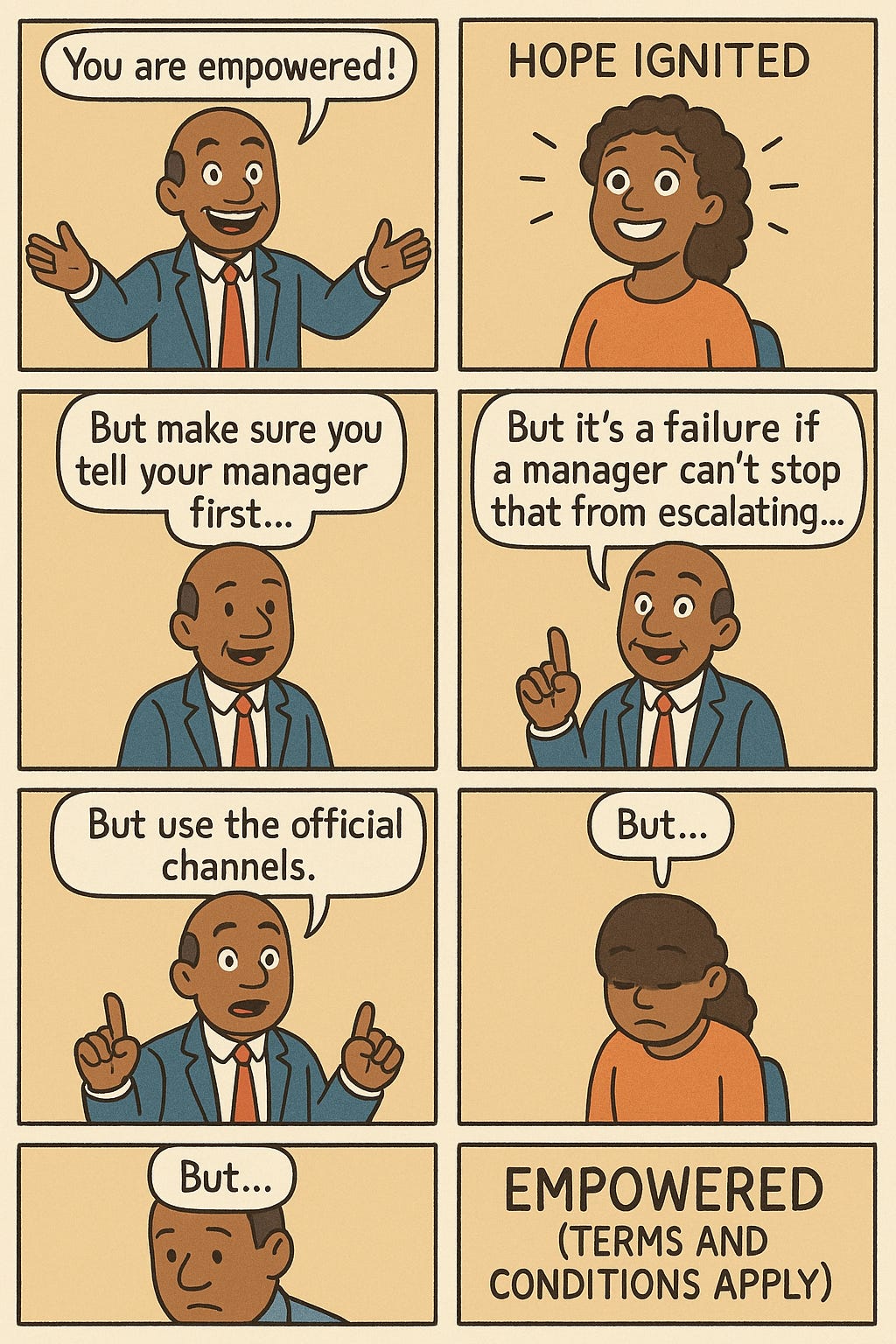
There's an emphasis on team independence and autonomy, but also fairly traditional ideas about the role of the manager (as gatekeeper, filter, escalation resolver, etc.). In many ways, these ideas are complementary to one another. After all, how else do you achieve empowerment and independence without holding someone accountable for keeping things "clean" at the edges?
It's a bargain of sorts.
"We'll grant your team autonomy, but you, the manager, are responsible for ensuring that autonomy doesn't create chaos, need escalation, or disrupt executive focus."
Autonomy has strings attached.
To get things done, breaking through silos is rewarded. "We are one team here! Pull in who you need, cut across silos, take initiative!" But when it comes to feedback, concerns, "pulling the andon cord", or questioning the current strategy, front-line team members are expected to route everything up the official chain. Boundary-spanning is great for delivery, but not for dissent.
In many companies, the only sanctioned channels for dissent are barely channels at all:
1. The engagement survey (twice a year, maybe acted on).
2. The all-hands Q&A (if you get called on, and your question survives reframing).
3. Slido (if the comms, branding, or legal team doesn't quietly delete it).
4. Taking huge risks to try to contact a skip level.
Or…talk to your manager. Always: speak to your manager.
Like anything, this style of operating is optimized for something. In the case of tech companies, it's optimized for scale, growth, productivity, the perception of local independence, and local problem solving.
Which works (by some measures) until it doesn't:
For mission command to work, you need clarity of intent, high trust, coherence, the ability to escalate without penalty, and a culture that values the "process" of providing feedback and problem solving. In professional militaries where mission command thrives (e.g., NATO doctrines, modern U.S. special operations), it's not just about decentralizing execution, it's about building the conditions that make decentralization safe and effective.
In fact, militaries train explicitly for situations where mission command might break down, such as when communications fail, leadership is cut off, or conditions on the ground shift faster than the plan. That’s pretty meta.
By contrast, tech often adopts the language of mission command (e.g., autonomy, empowerment, intent) without investing in the hard infrastructure of trust, shared context, and safety necessary to escalate. Which leads to:
"You're empowered. But if things go sideways, it's on you."
"You should take initiative. But don't challenge the strategy."
"We trust the team, as long as you don't cause problems upstream."
So what's the answer, especially these days when many companies are mired in low trust?
1. Accept it.
This is the gig. This is normal. This is your average modern organization. Even "high-performing" companies often operate this way. They're not military or sports teams, no matter how much they like to borrow those metaphors. They are sprawling, internally inconsistent entities held together by incentives, inertia, and the occasional burst of clarity. Let go of utopian views about how companies work.
2. Carve out your bastion of hope. Learn to code-switch.
Get fluent in both realities. You won't be able to fix the entire system (in fact, in many ways it is what it is, and isn’t broken), but you can create a local pocket of safety and trust. If you're a formal leader, you can protect your team and encourage feedback. If you're not, you can find allies and build something functional together. Find a workable boundary of trust and contribute within it. And take care of yourself for chrissakes.
3. Stay disappointed.
You can also wish your company operated differently than it does. Hope it becomes more principled, more coherent, more human. And then carry that disappointment with you every day. Some people do this for years.
4. Find better.
Some companies work differently. Or at least try to. Or at least have a couple “glory years” when things click. They may be rare, and they will have tradeoffs, but they exist. If your worldview fundamentally conflicts with how your company operates, it may be time to consider alternatives. Don’t rule out other parts of your org. The difference can be stark.
Are you aware of Corporate Rebels https://www.corporate-rebels.com/ . They are doing great work in this space. Answers to these problems are co-created... Change begins with invitation.
As ever, thoughtful, insightful and ... on the money