

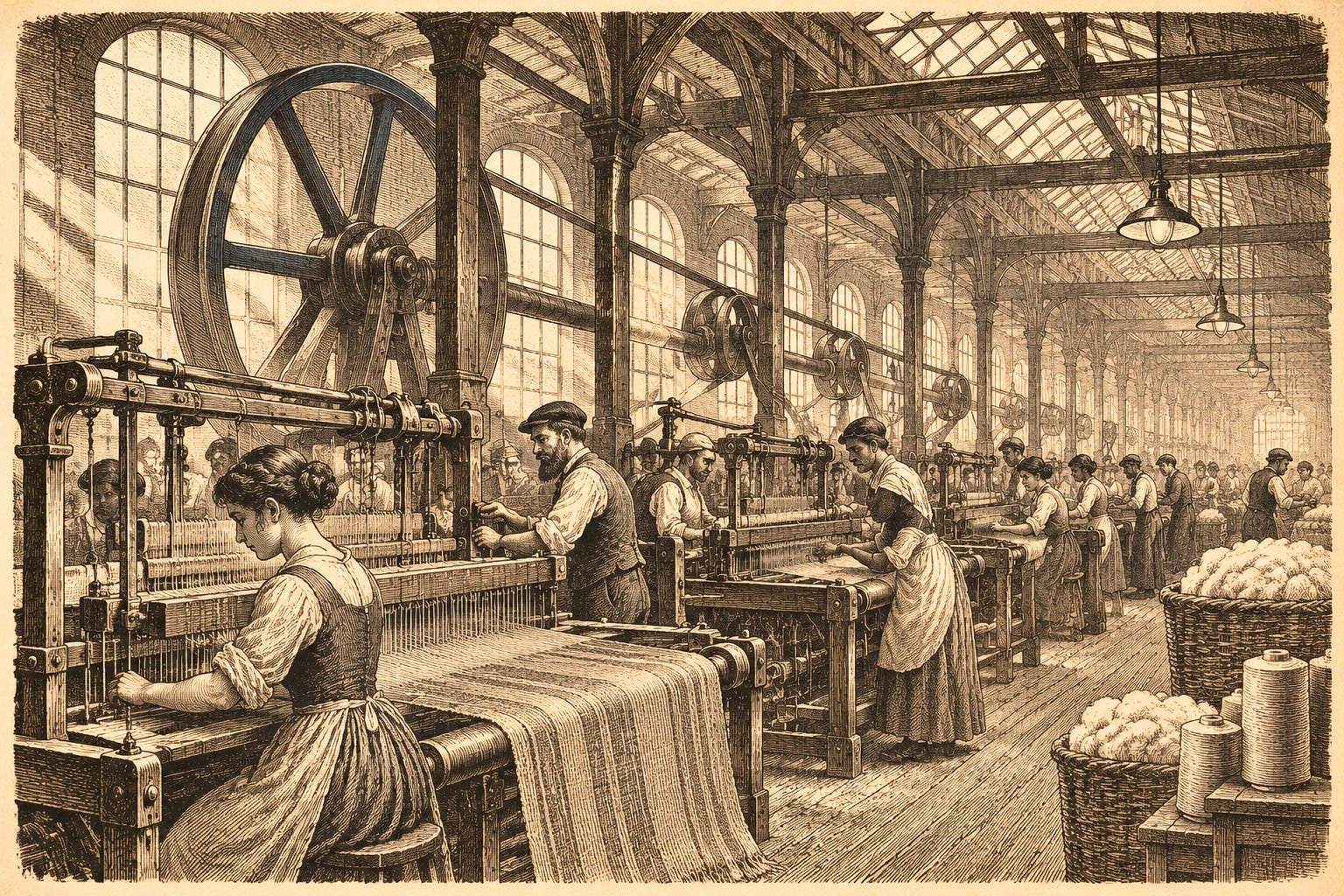
“Software factory” is a kind of identity defense (and branding). And there’s a historical precedent here.
I’ve been pondering the almost Dionysian fervor surrounding all these new “factories” people are building. The sheer exhilaration, obsessive energy, and unmistakable pride people seem to take in building systems that build things.
Imagine your whole profession of “building” has shifted. Things that underpinned your identity are no longer considered valuable. Historically, your expertise gave you considerable influence over what could be built, how it would be built, how long it would take, and what trade-offs were necessary. Suddenly, the act of producing software became dramatically cheaper. Your traditional source of scarcity (and therefore power) is threatened.
What do you do?
You move up a level. You become the architect of the software factory. You control the orchestration, infrastructure, standards, quality gates, security, evaluation, and deployment systems. You may no longer have a monopoly on producing software, but you can establish authority over the means of production.
When technology automates work central to your professional identity, one attractive response is to become the person who designs, operates, and governs the automation. That can be productive adaptation, genuine craftsmanship, identity preservation, and a defense of professional authority. All at once.
This is not new. As industrialization transformed traditional crafts, some skilled craftspeople shifted their attention from making things to designing the systems that made things. For example:
Eli Terry (clockmaker → clockmaking machinery)
Josiah Wedgwood (potter → factory design and production systems)
Henry Maudslay (metalworker → precision machine tools)
Joseph-Marie Jacquard (weaving → programmable looms)
Frederick Winslow Taylor (machinist → scientific management)
You shift your focus to “building” a factory. It is like CI/CD, infrastructure as code, automated testing, deployment pipelines, and developer platforms. But now for AI agents. You get to preserve the identity of being a builder.
Let’s go back to 2012. What were we debating then?
Netflix’s Adrian Cockcroft described an organization with little need for operations staff, because the cloud let them automate so much of the old work. John Allspaw at Etsy called “NoOps” “the dumbest marketing term ever coined in my field.” Julian Dunn wrote a post titled “Chef, devops, and the death of system administration,” and argued that “pure systems administration is eventually going to die out as a profession.” Jez Humble argued there’s no such thing as a “devops team,” and then conceded that somebody has to build the platform developers use to self-serve. Around the same time, James Bach and Michael Bolton drew a line between “testing” and “checking,” so that automating the checks wouldn’t be mistaken for automating the tester.
Same dynamics.
In an idealized version of product development, I’ve always imagined the cross-functional team taking precedence. It has an identity of its own. Makers. Value generators. People with different skills, perspectives, and experiences coming together to figure out what is worth building, how to build it, and how to learn along the way. Inclusive building. The team is the unit of value creation, not any particular function or discipline. The team collectively owns the problem, the discovery, the decisions, and the outcomes.
What I think is happening right now with the “software factory” is that the narrative is emerging primarily from within the engineering community, partly for the psychological and identity-related reasons I’ve been discussing.
There’s also a practical reason.
Some of the earliest and most measurable productivity gains from AI have been in software engineering. So it’s understandable that engineers are among the first to experience both the extraordinary possibilities and the threats to their established expertise. And it’s understandable that they’re imagining the future through the lens of their own craft: orchestration, pipelines, infrastructure, automated testing, and factories.
It’s perfectly logical, for all the reasons mentioned, that we’d gravitate toward the software factory metaphor. But it’s an open question whether the emerging factory model is actually a good fit for the domain of end-to-end product development, where discovery, design, building, experimentation, and learning are deeply intertwined.
And it’s not just software engineering. Everyone seems to be building a “factory” right now, whether they call it a software factory, a product management system, a GTM factory, a content engine, or something else.
There’s a much broader movement underway. As AI threatens the skills, expertise, and activities that underpin our professional identities, we’re embracing the technology and trying to position ourselves one layer up. Instead of doing the work, we design, orchestrate, and govern the systems that do the work.
It’s a way to preserve our identities, demonstrate our continued relevance, and potentially establish a new source of organizational power.
What isn’t happening nearly as much as it should is a serious consideration of the cross-functional nature of the problem. Most of these emerging “factories” seem to stop at the boundaries of existing professions. Engineering-led software factories are often remarkably abstract about what happens upstream and downstream of software production. Product management factories tend to stop where the software factory begins. GTM factories focus on their own slice of the value chain.
And poor design is sitting somewhere in the middle wondering WTF is going on.
We’re all enthusiastically building systems that preserve our professional identities and potentially give us a new source of power, but we’re still organizing those systems around the very functional boundaries that cross-functional product development was supposed to transcend.
We’re reimagining the future of work one professional silo at a time.
This resonates so much. I'm a software engineer by trade, but done time in DevOps, management and (lower) exec too, managing product managers.
I'm looking around at other software guys around me as they retreat into their own silos with only Claude and their imaginations, replacing the discovery and creation we used to do as teams with show-and-tell, where even the tell is written by Claude. I look on with a kind of despair as previously reasonable individuals seem to have convinced themselves that despite continuous ongoing efforts to corale and cajole and correct, and still missing basic issues, "self coding is over", while they pull the ladder up behind them for the next generation of software professionals.
I have been pondering what has been driving this "individualisation" of engineering again and your thoughts here make a lot of sense. I only wish there was more self awareness, and less FOMO from hype train narratives, so we can actually figure WHAT AI can actually do for our "cross-functional product development" teams, together.
The identity lens suggests a useful question for any team building its own factory. Ask, "Which part of this system exists because it solves a customer problem, and which part exists because it keeps our role central?" Writing both answers down before the next planning session makes the trade-off easier to discuss without it feeling personal.