

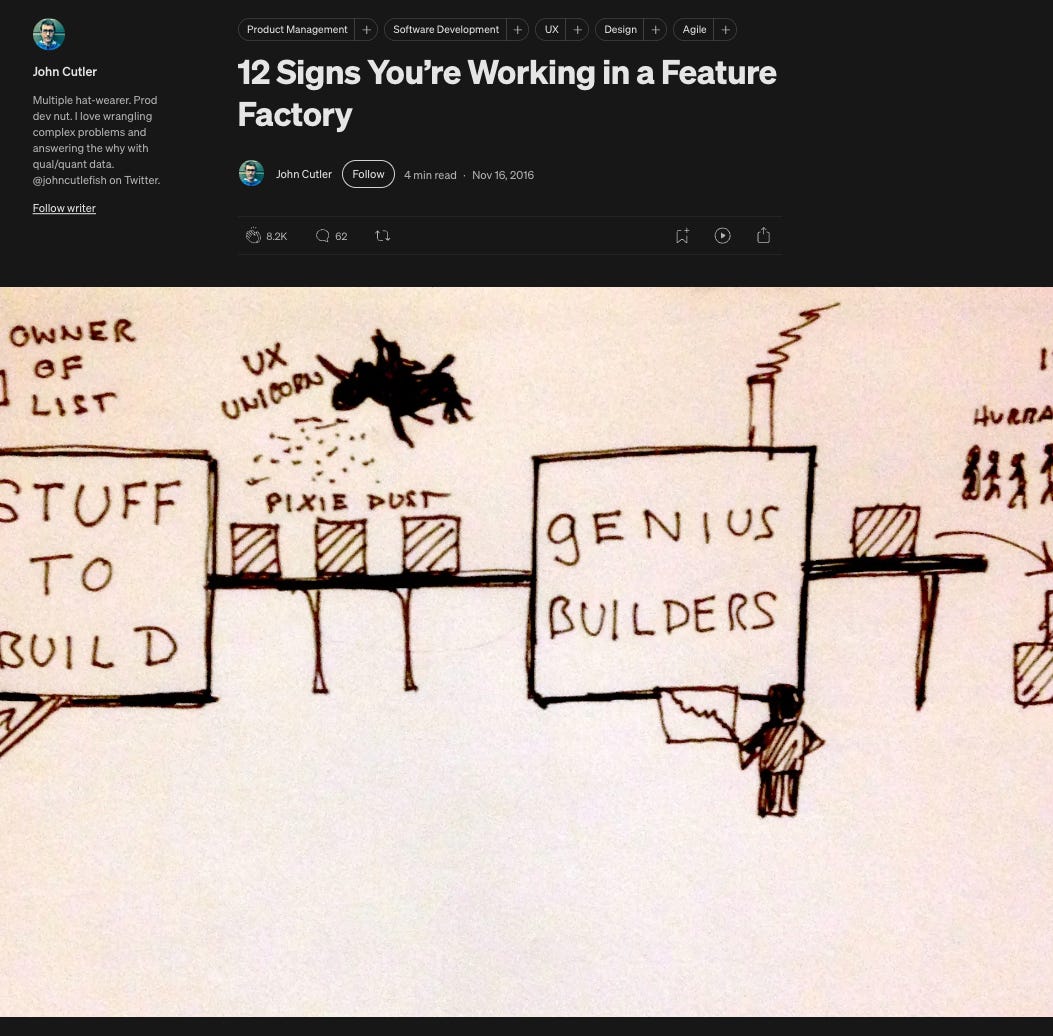
10 years ago I wrote a post on Medium about Feature Factories that literally changed my life. Funny story: I was trying to get a Medium researcher to understand something. I wrote the post in a couple minutes to “prove” that the punchier, more hard-hitting, more judgmental, and more “oh, I’ve seen that before” a post was, the more traffic it would get. I meant what I wrote, but I was struggling to explain how the longer I spent on a post, and the more nuanced I tried to make it, the less traffic it got. So this was my way to “prove” that.
Anyway, it went “viral,” hit Hacker News, and I eventually got a job I really liked because of it. And it kicked off a lot of my writing for the last ten years. I’ve written close to a 1000 posts since. It has been a fun ride. I don’t write stuff like that anymore, but I love returning to it to explore my thoughts.
Every couple of years since then I have written a retrospective of sorts. Here are some thoughts on the post, ten years later. I have an app called Flowstate that sits you down in front of a blank (full) screen with a timer, and if you stop, try to copy-paste, or try to navigate, it all goes away.
Timer engaged.
You Are Working in a Feature Factory
First, you ARE working in a feature factory. So you don’t need any signs. SOMEONE in your company thinks about product in terms of what features you’ve shipped. Once you come to grips with this, life becomes clearer. They aren’t stupid, either; they just haven’t seen any of this work. Or seen it working somewhere—like working at a feature factory that kicked ass, where they didn’t really understand what made that work (it happens). Or you are working in a/an ___________ factory (more on that later), which is a dominant mindset almost everywhere.
So you are. The trick then is what to do about it and stay sane.
Beyond the Binary
Ten years later, and I’m tired of all the ____ vs. ____. Outcomes vs. outputs. Projects vs. products. I was a major purveyor of this, as well, in countless ___ vs. ___ diagrams. They make work seem like a 0/1 situation when you’re typically doing all of it anyway.
Maybe these things were useful bugworms in executives’ ears, but I’ll always remember sitting around with a team from a company frequently touted as being product-forward and someone saying, “This is weird. We use projects. We have products. We care about outputs AND we care about outcomes. Sometimes we just ship things; other times we do a lot of exploration.” The whole idea that the rest of the world was wrapped around an axle with these false tensions was really funny to them. “Do they honestly think we don’t have executives bearing down on us saying ‘ship faster,’ ‘ship faster,’ or cooking up metrics, or that we don’t have tension between output and proving long-term outcomes? That’s sad… it is the job. I hope they aren’t beating themselves up about this, because it is hard everywhere. Yes, we have more leeway because of the history here, but we aren’t out of the woods.”
Those diagrams, and by extension the feature factory post, were a helpful way to get people talking and made the world nice and simple, but the world isn’t simple.
The projects → products thing caused a lot of companies to name everything/anything a “product,” over-hire product management, set design/UX back, “install” an “operating model” as if it was plug and play, and generally lose sight of first principles. During ZIRP, even “high performing” product orgs tried to go “multi product” and turned everything into products even when it made absolutely no sense to customers. It also had the effect of turning anything further down the stack (platforms, etc.) into a second-class citizen, or forcing it to adopt customer-facing product language to justify existence. Another thing: teams/companies forcing premature convergence, premature hiring, and premature branding around “new product teams,” when the context was completely off. A lot of layoffs were caused by this logic.
Especially in this dynamic climate, it is better to think in multi-quarter bets with a real business case than imagine every team will last forever in its current form (with all the pomp and circumstance of GMs and VPs). Flatter, more grounded in economics, fewer perverse incentives.
More clarifying is the shift in funding/governance mechanisms. That’s the first principle many orgs missed. Somehow “product” became a magic call word and led teams astray. I mention this because “feature factory” and “product centricity” often show up together, and I’ve been thinking about that a lot lately.
Proxies, Trust, and the Work
As proxies go, features aren’t the best, and they aren’t the worst. At least in theory you end up with something reasonably usable. A well-oiled feature factory getting reasonably usable features into production, where things don’t immediately implode and they’re not sitting around digging out from a mountain of bugs, would be a massive step up for some teams.
Similarly, there are a lot of teams seemingly skilled in all things discovery, frameworks, etc.—that can’t ship. They can’t think big, work small. It isn’t that those activities are bad, but they are not really balancing it out on the other side. It can feel sometimes that the team is more comfortable talking about all the stuff they want to do and checking a lot of the theoretically correct things to do, living in Miro boards and docs and strategy meetings, than they are making those tough decisions to put finger to keyboard (or agent to keyboard, or whatever) and making it happen. I say this as a big advocate for many risk-reduction approaches, by the way, but it can feel sometimes that people have lost the plot and they’re trying to reduce uncertainty to the point of being 100% comfortable, vs. taking the plunge.
When you have low trust, or low familiarity working together, or you have a million dependencies to coordinate, sometimes all you can do is rely on proxies. That’s what humans do. I’ve seen high-performing teams reduced to a full, unabashed feature factory motion because anything else would require a leap of faith, a commitment to testing a hypothesis, or… conviction mixed with the confidence that they are supported and can act. Features are as good as you are going to get.
You go through “problem definition” theatrics, but the trust/comfort replacement becomes things people can imagine, things that are tangible, etc. The prospect that things fail all the time is simply not palatable. The team HAS to agree on the proxy to make forward progress; otherwise, it’ll never happen. Look at how transactional project shops work. Yeah, they might pitch outcomes, but because there’s not necessarily high touch with the client, all you’re going to get is agreement on a spec.
And here’s the reality: problem statements, metrics, opportunities, OKRs… these can all be proxies as well. They are an agreed-upon game meant, in some cases, to gloss over existential angst and the fear of actually working together. How many teams do you know who “focus on problems” but somehow never admit they didn’t solve the problem? Or who don’t move the metric but say they are moving the metric? Or who drive themselves in data circles, never revising their metrics? Promotion-driven development is rife in the companies that, in theory, are all about outcomes. In other words, you can run a _____ factory in a million ways, all with seemingly “outcome-oriented” undertones, and never really get to the crux of how hard this work is and how much honesty and trust you need to embrace that.
The Human Stakes
An interesting part of the post was the emotions it (the post) elicited. That feeling of being stuck in a machine that doesn’t really care. Of having people around you who feel your progress can be measured one way when you believe there is another way. Of having people swear up and down that you “just” need to ship X, and everything will work. Of your progress/value being boiled down to how many feature checkboxes you check off a list.
Looking back, it isn’t very well written. There are repeat items. I’m being cranky without giving much depth. But that is in stark contrast to the feelings people have expressed to me over the years about the post. They almost forget the post! It isn’t that important. But somehow it lit this spark for people.
I think this speaks to a much more human thing than just whether you’re feature-oriented, project-oriented, or “outcome-oriented.” We all want a sense of impact in our work, of some sort of epistemic honesty, of making a difference. And we all want to be respected and used for the craft we love… the things we know how to do, and the ways we know how to help. When you don’t have that, you are losing such a huge opportunity as a company. To me, that is the bigger issue here.
Sure, some of the feature factory stuff is about ignorance and people basically never working in an environment that did some of those things and assuming that was the best you can do. Some of it is about out-of-touch leaders who just want output and think their ideas are the best in the world (memo: sometimes their ideas are pretty good). But some of it is the continuous challenge of imbuing meaning in our work and work identities.
It’s a Spectrum
Every problem is a nested solution to a higher-order problem. Every input is an output (to some degree). Every outcome is a tactical, siloed step to a broader, messier, more complex, more nuanced/narrative-filled outcome.
I say all the time these days: “Look, a feature factory isn’t a 0/1 thing.” You’re not in it or out of it. You’re always a feature factory to some degree, even when you think you’re doing validated experiments. Because that near-term impact is locked into a much bigger graph of ideas through linkages with varying degrees of certainty. So if you are in this business, you better get used to that! To quote Greg LeMond, with variation, “It doesn’t get easier; you just start focusing on a higher level of abstraction.”
Platform teams, especially, or anyone further down the stack understand this. You can be as outcome-oriented as you want, but if someone doesn’t buy into your causal chain to impacts on revenue and costs, you are SOL. In fact, you’d be better off running a feature factory in that case while running some experiments/measurement on the side. So to anyone who dreams of hitting the “problem focus” Shangri-La, I’m sorry, but it doesn’t exist. You will STILL be challenged on what you ship. You will STILL be challenged on how it contributes to revenue across some span of time.
Performative Outcome-Centricity
This is the UXR/designer in me speaking, but there’s often so much hullabaloo about outcomes, “jobs,” etc. that people rationalize shipping pretty fricking unusable designs, based on research that was flimsy at best.
This is the reverse of the “ship more” argument above, but I get the feeling that the outcome/goal/problem machinery in companies is often so prevalent, so baked into the “way” for many teams, and so many PMs now have internalized that they are somehow the manager of the “outcome” workstream, that we’ve actually gone way too far. You can make the absolute best case around outcomes, metrics, etc., etc., but end up shipping a product that checks all those boxes under the mantle of being “minimal” or “let’s check the outcomes.” It is the same problem, again, all over again, just with different words. Before it was “ship the feature”; now it is “ship all the outcome frameworks and rituals to show we’re VERY sure this will work.”
The me of 2016 was very sensitive to the outcome side, and it was 10 years ago, but it is like the whole wave that emanated out of that kind of challenge (with all the focus on OKRs, opportunities, Lean UX, jobs to be done, etc.) has come full circle to where on one side you have all this high-level, hand-wavy math, and on the other side you have prompts and specs, and there’s no tinkering, shaping, hands-on-the-thinging actually happening anymore. If there is, it is because someone “just built a prototype for fun,” and teams are like, “OK, ship it.” That’s not a prototype!!!!
This point might not be as fully fleshed out, but you can tell the emotion is there with me. I could just be responding to the chaos of AI at the moment. Another thing: PMs incentivized by the “business case” and “justify every outcome” culture are using AI to create slop tornadoes. LLMs are very good at connecting everything in seemingly realistic ways.
Sometimes Features Are the Answer
This goes without saying, but sometimes the answer is to literally make a list of features and ship them. There are absolutely situations where this is the right thing to do. This makes teams highly uncomfortable. But the interesting part is the debate over when and where that is the right thing to do. There are many, many products, especially now with AI, that are changing some aspect of a motion that has been “solved” for decades. Are you really going to argue with decades of feedback? Where’s the line?
I worked at a company called AppFolio that did a GOOD job of this. They were entering a domain that had been around for a while with on-prem software. They knew they weren’t going to reinvent property management accounting, so they reverse-engineered that. Feature factory for the win. But they also made bold bets on segmentation, where operators would be willing to go with FEWER features in the current landscape, and where new technologies afforded new opportunities. It was a MIX.
And this kind of goes to the idea of what a feature is to begin with. Where do you draw the line? Is an age-old capability that people will JUST NEED a “feature,” or is how you solve it today with AI “the feature”? It isn’t as easy as you think to answer this.
My last company, Dotwork, is/was making the bet that a lot of the long-tail features that legacy SPM providers had built would either not be required or would be so different now with AI that it would be worth a refresh in approach (or avoiding them altogether). Will that bet hold? Or will they get pulled into the old world? Who knows?! That’s the fun of this game.
What Actually Holds Teams Back
This will be a review for anyone who reads TBM, but you have to keep in mind ALL the structural challenges that can hold back a team and keep them stuck in (detrimental) feature factory land. Direct access to customers. Direct access to data. Enough autonomy to avoid premature convergence. Training (yes, sometimes it is a skill issue). The promotion structure, as mentioned above. So. Many. Things.
Yes, I believe we all have agency to TRY something. But that doesn’t mean that something will succeed. When I wrote that, I had not yet worked at Amplitude, met hundreds and hundreds of teams, or observed how crafty people were when it came to running small experiments (good) and what they were up against in their current jobs. A lot of these things are not vibes or mindset—they are literally investments. Money. It costs money to work on your data stack or buy stuff. It takes money to have enough designers on staff to prevent premature optimization. It takes time and money to engage HR in really working on promo structures based on behaviors that counteract the feature factory. If you want to call these “excuses,” that’s fine, but to that I would ask if you have endless political capital, time, and will to do all of this for what will turn out to be but one job in your whole career.
I would challenge folks, however, to get away from 0/1 thinking. An “outcome” in your world might be literally scheduling a short call with a customer using something new. Or instrumenting one data point. Or getting ONE narrative about whether this worked or not.
I hate how people get lulled in by ONLY the best stories, by the highlight reels of highlight reels, by companies literally printing money. As if that is the only way to work and that is the bar. You aren’t seeing the rest. I’ve worked at some pretty great companies, and life is always a continuum between a lot of stuff going wrong, some stuff going meh, and then some standout wins. Long slogs. Murky data. Unclear strategy. A continuous effort to resolve all that.
Experimentation and Conviction
The dream of controlled experimentation. As a general rule, any feature immediately adjacent to cost/revenue, with a short loop for experimentation, should already be the active target of experimentation; otherwise, your company is losing out. Just do it.
But there are many product challenges where controlled experiments are not possible. You are going to need to find other ways to gradually reduce uncertainty. It will not be perfect. I have a sense that when people read the original post, they imagined this utopian setup where, for EVERYTHING you did, someone was going to give you a thumbs up / thumbs down, a % lift, or an “it failed.” It is nice when you can do those things, and you should try, but you can’t carry those expectations to other things you do in product.
Almost by definition, if a strategy is measurable down to a controlled experiment, then it is a short enough loop and a siloed enough / clean enough causal graph that other people are playing the exact same game. There’s a reason why companies COMPETE directly on landing page optimization, etc. But it is also a brutal head-to-head battle. Many of the longer-burn strategic things you do will be more like pseudo-experiments or (insert words here to describe them).
The power of conviction. Data can boost conviction. But conviction can eventually lead to collecting data. At a wide enough span of time, you NEED conviction. In my experience, teams that beat the factory often do so out of conviction. Conviction in that way of working. Conviction triggered by terrible screwups in the past where they were convinced they knew everything, but it ended up backfiring. There is an irrational part of this at play that simply “proving a feature didn’t work” cannot solve. Because depending on their mindset, they’ll just call that an exception.
Conviction is a slippery thing because it can also drive your product over a cliff when you’re unwilling to accept what is happening. But the tension is REAL. Especially if we are attempting to create a future that doesn’t match the past, to bring something new into the world, to do something that on the surface seems irrational right now, you’re going to have to plod ahead and walk the path less traveled.
The Game Starts Before the Team
Beating the feature factory begins with the rationale for forming the team or work group and how the game is established from the very start. It is cliché to always point to strategy as “the problem” (just like pointing to a bad apple is often the easy way out). The causal narrative is too seductively pleasing.
But at some point, someone sold the org on starting the team, and they made a bet that extended beyond features (hopefully). They set the game in motion. They had opportunities to get a real business case in there and to encourage the team to think about being able to rationalize their work in core economics (in a healthy way). They may have assigned a VP, Director, or PM with ways of working locked into their head.
It is VERY DIFFICULT to rewind the clock back to that meeting with finance and change the game from a feature factory game to an outcome/economics-backed game. This is the importance of org design, but going beyond the typical boxes and arrows, journey maps, and JTBD-to-team assignment bingo that all look good on paper because they match a Miro board and nice, neat categories but fall apart the second someone talks about outcomes.
AI Amplifies Both Directions
So much to say, but apparently factories are all the rage right now. Software factories. Spec-driven development. Getting your “swarm” of agents building, etc. A couple thoughts. Imagine the possibilities if you can thoughtfully use AI across the full loop to wiggle out of a feature factory. It is pretty good at instrumenting analytics. It is decent at connecting more signals. It is decent at rapid prototyping. It is decent at re-contextualizing your work for different audiences to elicit the right feedback. You can use AI in so many ways to beat the feature factory. Heck, you can have triple the number of shots on goal.
And, of course, you can let it accentuate all of your bad habits. I heard recently of a team that was AI-PRD-ING it up. Suddenly, everything was clear! The reasonable-sounding PRDs were eliminating back-and-forth. Bad, bad, bad.
They had taken a toxic doc culture and amplified all the crap. And, by the way, they were very “outcome-centric,” because if you really want to make business cases that no one will look at (or they’ll just ask their LLM to look at), look no further than AI. You have teams that were never talking to customers in the first place, talking to machines pretending to be human at your beck and call. This is mind-blowing. Like positioning synthetic personas as an answer to teams looking for the easy way out… they aren’t even in a position to determine where the boundaries are.
I would say that for AI it boils down to amplifying the bad habits, and creating leverage for the good habits.
OK. Nearing the end.
It has been a fun ten years. That post helped me get my Amplitude job, which helped me meet so many great teams, further my understanding, etc. The whole vibe and reality have shifted. The problems and opportunities feel much more serious than whether you ship some features sometimes (or not). You have people blissed out, about to enter an echelon of phenomenal wealth. And people leaving tech. And people pondering whether they might ever get a job again in the industry. I’m projecting my own innocence at the time, of course, but it feels like I was wrapping my head around one tiny part of the iceberg. I’m much more interested in how people show up in the weird places we call work than whether a place passes some kind of arbitrary benchmark of being something or not being something.
Maybe above all things that is what sticks with me.
The desire for impact, truth, craft, etc.
Counting OKRs and problem statements as proxies too means an outcome framework can be its own factory. In my nonprofit work it shows up as outcome reports written for funders, and AI makes them cheaper to produce than to read.
Ten years later and AI just made the feature factory faster :D. Do you see many teams using it to actually get out of it?