

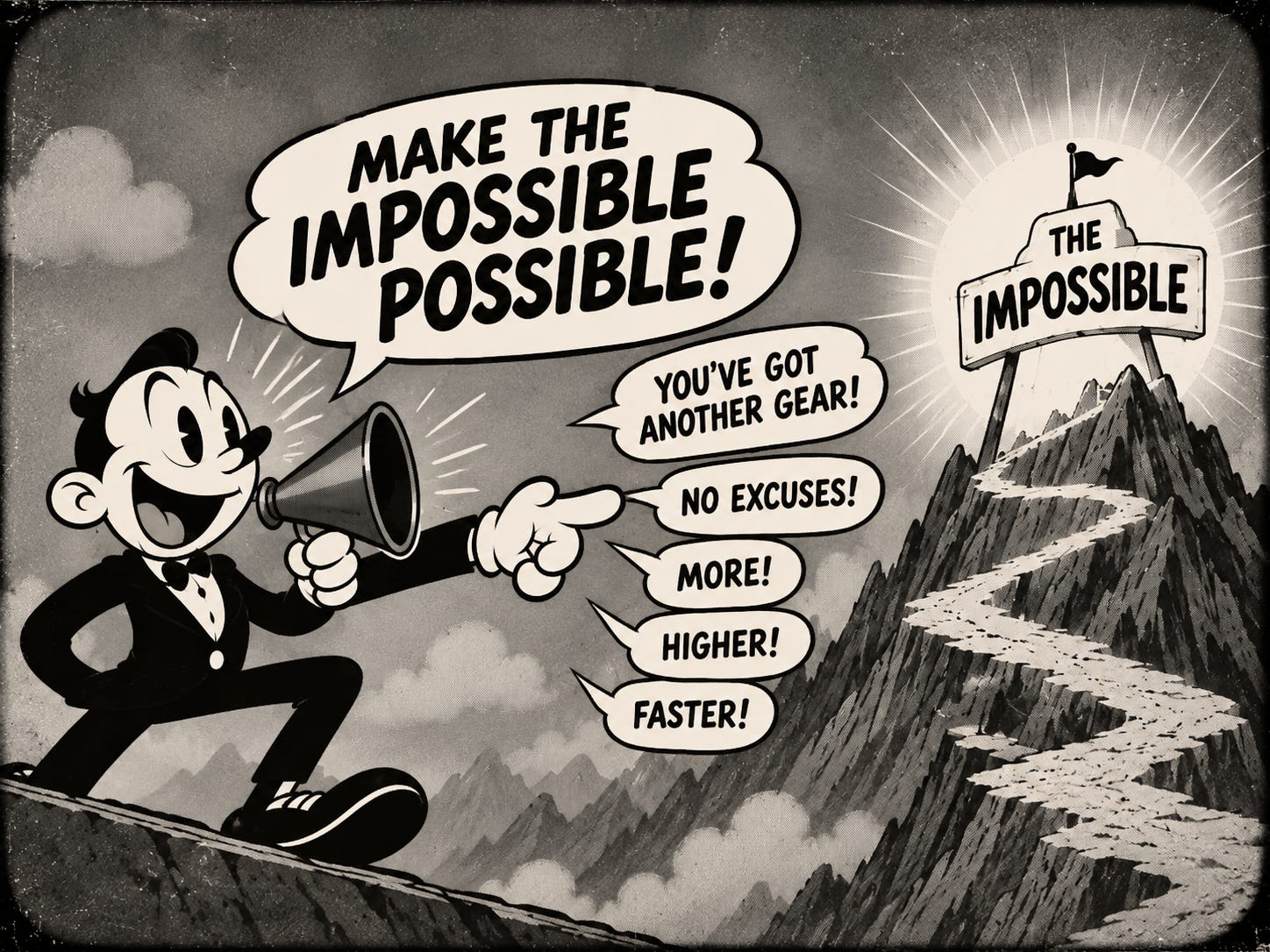
May I present to you: The Standard-Setter. The Standard-Setter’s superpower is failing upward while confusing pressure with motivation. They believe everyone has another gear, and that their job is to force people into it.
The Standard-Setter operates from a simple belief: that by merely telling you to “make the impossible possible,” and by “setting extremely high standards,” they can somehow magically make you more effective.
But they often have no idea what they’re actually talking about. They don’t demonstrate the thing by example, or their example comes from a completely unrelated domain. What they have internalized, deeply, is the identity of a high-performance leader: someone who demands excellence, refuses excuses, and gets “more” out of people.
What they often dismiss is the fact that you could get the same results w/o driving everyone crazy and wasting energy dealing with them.
Statistically, it is probably safe to say that we are all “capable of more” under certain contexts, for certain periods of time, and with varying second-order costs. So the Standard-Setter will inevitably accumulate plenty of evidence that what they are doing “works.” Someone rises to the occasion. The mistake is treating those observations as evidence of impact rather than simply evidence that people can respond to pressure.
The Standard-Setter isn’t like a trusted coach who has worked 1:1 with LOTS of people over the years playing a very specific game. No, the Standard-Setter sort of naively adopts the worldview that pushing people harder is itself a form of leadership. And then, oddly, they expect some of the loyalty and trust we might give a great coach without having earned it through expertise, attention, shared experience, or demonstrated understanding.
The Standard-Setter also tends to hallucinate that they have somehow figured out how to motivate *everyone* with their approach, missing that a lot of people don’t respond to pressure, exhortation, or someone else’s intensity. They respond to clarity, trust, autonomy, meaning, mastery, good feedback, and the feeling that their effort is actually connected to something worthwhile.
A great coach or teacher knows this. They don’t try to motivate people the same way.
The Standard-Setter sounds like a broken meme, cajoling everyone with the same platitudes.
Standard-Setters can also make remarkable upward progress in organizations because their style is extremely legible from above. They look ambitious. They can point to moments when teams stretched and “won.” The costs, meanwhile, are often dispersed downward: exhaustion, resentment, churn, and the energy required to manage the Standard-Setter themselves.
If there is one solace, eventually the Standard-Setter has to show what THEY can do, or meet their match in someone with enough influence that they CAN’T bully. The trick only works as long as the Standard-Setter can keep converting positional power into apparent performance.
They’re close friends with windbags like The Powerpointist & The Bulllshit Artist. 🤝
They’ll whip up fifty slides with three in the appendix. Prepare youself with the mute button, because they’re reading you the eye chart. 👀
https://jeffbailey.us/blog/2024/08/23/death-by-1000-cuts-10-word-buffer-overflow/#windbags
I've seen this distinction in operations. Setting ambitious targets is perfectly reasonable, but a leader also needs to ask what has to change to make those targets achievable. If the answer is always "work harder" rather than better processes, clearer priorities or additional resources, the team eventually pays the price.