


Have you ever felt like a complete weirdo in your company? Like there are only a handful of people who “get you”? Or have you gone to a conference and gotten a little confused because suddenly it seems like you have a lot more in common with everyone? Then you return to work, and somehow the weirdness comes back.
You may be less alone than you think.
One mistake we make is assuming that because an organization has certain rules, and because a handful of high-profile people seem to behave a certain way (and everyone seems to visibly go along with it), that there simply aren’t many people like us there.
Organizations can be more diverse in belief than they appear to be in behavior. What you see is not simply “what people here believe.” You’re seeing at least three things layered together:
Power-weighted norms, where some ways of behaving carry much greater institutional force and consequence than others.
How people adapt to that environment: what they say, suppress, emphasize, tolerate, and avoid in order to operate effectively within it.
The actual people underneath, who may hold a much wider range of beliefs, values, preferences, and ideas about how work should happen.
The key is that we mostly observe #2, attribute it to #3, and underestimate the influence of #1.
Leaders influence what gets rewarded, promoted, tolerated, and interpreted as “leadership material” and “good performance.” People adapt accordingly. That visible adaptation can then look like widespread agreement with the norms themselves.
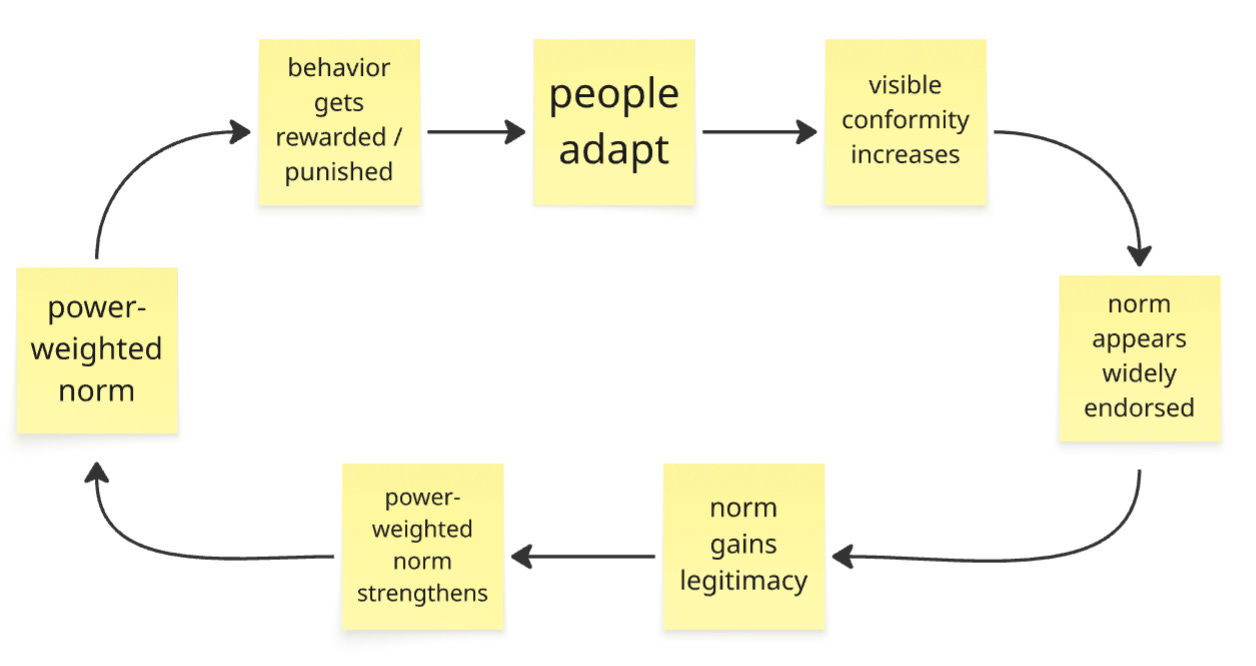
This can create a reinforcement loop. People see others behaving according to the apparent norm and reasonably infer that those people believe in it. Their own adaptation then becomes another data point suggesting the same thing.
A relatively narrow set of norms can start to look like “what everyone here believes.”
But adaptation is not the same thing as endorsement.
People can have very different reasons and go to highly varying ends to play the part their work demands. They may be optimizing for belonging, safety, ambition, professionalism, coordination, or simply making it through the day. It is easy to see this as inauthentic, but the behavior is visible.
Leaders are adapting too: to expectations from above, peers, boards, investors, customers, and inherited ideas about what leadership is supposed to look like. The fact that someone is rewarded for performing a norm does not mean the norm reflects what they would naturally prefer, or even what they privately believe.
And there’s another factor: a lot of things need to fall into place for people at work to reveal certain beliefs.
Some of it is luck: you happened to run into each other in the right setting.
Some of it is time: enough time to create trust and dig into each other’s perspectives.
And some of it is context: the right conversation, problem, relationship, or moment has to create an opening for that part of the person to actually show up.
Consider how many teams you’ve been on where it took quarters or even years to learn the why behind a certain quirk.
Social media has a similar norming effect. A relatively small, highly visible subset of people can make certain beliefs and behaviors appear far more common than they actually are. We observe what gets surfaced, mistake visibility for prevalence, and adjust accordingly. And some norms simply feel safer to perform than others.
LinkedIn is especially interesting here because we are still, in many ways, at work. People are visible to colleagues, managers, customers, future employers, and professional peers. So what gets expressed is shaped not only by what people believe, but by what feels professionally legible, rewarded, and low-risk.
That can make a narrow set of “safe” workplace beliefs look even more universal than they are.
In closing…
We encounter only a tiny sample of what the people around us think and believe. It is very easy to mistake what has been revealed to us for all that is there.
There may be far more “weirdos” around you than you realize.
For various reasons, it is normal to meet a couple of trusted people who really get you in your company. But you can’t let that convince you they’re the only ones.
Agree, though I'd put more weight on the power-weighted norms than on the adapting. I wrote about a manager following the advice to do 10% of the talking, sitting opposite a report following the advice to bring solutions rather than problems. Both good rules, followed properly, and the hard thing never got said. I ran mine that way for years and every proxy came back green.
Insightful article, and your sentence, "But adaptation is not the same thing as endorsement" resonates and sums up human behavior at work. To the GENZs of my family I advise that they should adapt (as long as they do not compromise on ethical standards) while simultaneously honing their competencies so that when the right opportunity presents itself, they can capitalize. The environment for white collar workers is bad in the USA (as evidenced from the latest jobs report) and especially for GENZ. Leaders also behave in the same fashion as you have pointed out in your article. That's why the boards of large corporations are stacked with CEOs of other companies, on whose boards these leaders also sit. It is a mutual admiration society where endorsement is high. The folks who suffer are at the lower and middle levels only.