
TBM 436: Tension-Based Prioritization (A Non-Framework)

I’ve come to believe that teams can prioritize much more effectively by focusing less on the specific things they’re prioritizing (which will naturally be important, and will naturally get attention) and more on the tensions they’re observing and acting out day after day.
The tensions point the way to the real decisions. Most of what we call prioritization is forging agreeable narratives. It resolves very little and produces very little real commitment. But if you pay attention to where the same arguments/tensions keep surfacing, where conviction keeps failing, where momentum keeps winning despite everyone’s better judgment...that’s where you actually need to make the hard decisions.
There’s something Gestalt about this: you already perceive the whole shape of the problem. Your intuition is already doing that work. The framework just forces you to decompose it back into parts and lose the signal.
Later on in this post I share a simple, actionable exercise you can do with your team to surface these tensions. But before that, let me lay out my case.
If you like the newsletter, consider…
No One Retros The Framework. Why?
There are two parts to prioritization:
Prioritization judgement. What deserves attention and investment?
And then:
Prioritization-as-enacted
What would actually cause things to move in alignment with those priorities.
A lot of teams use prioritization to AVOID what is sitting right in front of their face. Instead of having the harder discussions, they slip into perpetuating the same old fake rigor and safe decisions.
I rarely, rarely talk to teams and hear “Oh well, during that prioritization exercise three quarters ago we really dropped the ball on prioritizing that because it was 3 not a 4.” Or “Woah boy, we really should have allocated 60% of our time there instead of 41.23% based on the CoD calcuation.”
I almost always hear something like “We just didn’t have the conviction to stop _______.” Or “We just kept plodding away on [something decided on two quarters before that] and everyone knew that was wrong.” Or “You had 20 teams saying they were slowed down by X, and we still didn’t have the political will to prioritize that measly platform investment.” Or “Let’s admit we were wrong about [that thing] and move on.”
The conversation in the retro is never about the framework. And always about how people rationalized, communicated, showed up, and made sense of things together.
Teams will spend hours/days/weeks trying to invent some sort of “defensible” system, when massive asymmetries and “problems to prioritize fixing” are sitting beneath their noses.
You don’t need more options! Or more spreadsheets!
The example I use is how as individuals we’re often swimming in the things we should be doing, the self-care we should be performing, the nagging tasks holding us back, and the big threats looming on the horizon that we can’t quite mobilize or motivate to tackle. Sitting down with a spreadsheet and trying to “reason things out” doesn’t solve the problem. The same with teams.
Most prioritization discussions obsess over prioritization judgement. But it is the recurring argument around prioritization-as-enacted that can be incredibly informative.
Instead of:
“Let’s prioritize again”
You instead should ask:
“Why has our existing prioritization process repeatedly produced this particular tension?”
Theoretical vs. Enacted Prioritization
The missing thing isn’t belief. It is commitment under present-day inconvenience. Good prioritization isn’t simply choosing the right work. It is recognizing the traps and tensions that prevent your portfolio of bets from panning out the way everyone claims it should.
I can’t count how many times I’ve been in a room where there seems to be a lot of agreement about some far-off threat—something we should do, something existential even, but not immediately existential. But for various reasons, despite the “priority”, the team can’t mobilize any sort of conviction. Maybe it will involve too many teams. Maybe there is currently “no clear owner”. Maybe there are differing opinions on how much energy to commit based on perceived levels of problem and solution certainty.
A lot of time, the key problem is that the problem is intangible. It is a future threat that people find all sorts of ways to rationalize will somehow work itself out. Every pre-mortem singles out the threat, and every quarter there are half-hearted efforts to take it seriously, but nothing happens.
When their guard is down, I’ll ask about some sort of existential threat looming on the horizon. There’s rarely disagreement about what that thing is. It doesn’t need to be rationalized. If there is disagreement, it is between markedly different futures with existential issues, or a comparison of existential problems (we need to live to even worry about that). Or magnitudes of disruption. The problem is imagining what action right now might look like. It isn’t some sort of rational, measured, economics-informed debate.
Is this a prioritization problem?
Well, yes, in many ways it is. But it isn’t the kind of rational pros vs. cons, risk, upside, effort conversation that people normally associate with prioritization.
Similarly, I can’t think of any work situation I’ve been in where there isn’t a priority people love to work on. The value is tangible. No one questions it. It is fun. It feels meaningful, at least on the surface. Saying yes has become a well-worn, habitual knee-jerk reaction, and no one is really complaining. In a meeting, trying to defend your value? Mention this priority. But there’s also a widespread intuition that it might be too much and that it is getting in the way of something far less comfortable, and maybe way less easy to rationalize. There aren’t enough guardrails. You’re running a very serious risk of exploring the wrong side of the effort/outcomes curve. No one wants to be the person to say “we can have a bit too much of a good thing”, but you really need someone to say that.
Is this a prioritization problem?
Again, yes. But because the work is happening right now, and because teams have a tendency of avoiding discussing the priority of “work in flight” (and because people get used to fun things that feel even a bit meaningful), you’re starting to drift from a standard prioritization motion.
Tension Patterns
Those are two motions. Here are some others:
Areas where you need to pass along a “default yes” because prioritizing all the individual items will not result in anything getting prioritized (the meetings are more expensive than just cranking)
Areas with a ton of inertia where someone needs to call a big reset to save the effort. The reset IS the item to be prioritized
Efforts that have been almost-done forever and just need one concentrated push to finish (different from the reset because you know the direction is right, you just need to stop tip-toeing around the close)
Priorities that keep boomeranging because there is insufficient data/discovery, so people keep saying “when we have more data”
Early-stage efforts that need care and room to grow, but not a free pass. The big decision is to really commit to planting the seed, and caring for it (without falling into “innovation lab” or “hire to get anything done” syndromes)
Effort blocked because you don’t have the “capability” yet. The big decision is whether to (and how to) build those chops
Important efforts where there’s a credible path to radically less scope that still captures most of the value (this is more of a lens, it can apply to almost any of the above)
Priorities that feel urgent because “the window is closing.” But is the window real?
Modest-looking efforts whose real value is indirect: they make a dozen other things faster or better. On paper they should win every conversation, but they get bogged down because the priority is less sexy, and everyone wants the benefits without funding/helping that shared capability (crisis of the commons)
There’s a polarity between many of these. You can’t do everything at once. You can’t cap the comfortable thing AND do the consolidated push AND plant the seedling AND fund the capability gap all in the same quarter. You keep a tight portfolio of risk profiles across time, value, and urgency. But it is not nearly as mathematical or rational as we think. It is more like managing tensions: knowing which ones to hold, which ones to release, and which ones you’ve been avoiding.
My theory is that even when we try, we’re not doing any sort of “rational” prioritization. But instead of fighting that, you can actually use prioritization tensions as a signal on the way to a more balanced portfolio of bets.
Conventional discussions of prioritization assume something like: “We have several plausible things we could do. Let’s compare value, risk, effort, confidence, etc. and decide which ones to invest in.”
But in my experience, the real problem starts AFTER that. We often know what we should do — that isn’t the problem. We know what the existential threats are. We already know we’re overinvesting in some things. We already sense which projects need a reset. What we’re struggling with, or don’t have the conviction to do, is how to create the organizational conditions required to act on that knowledge.
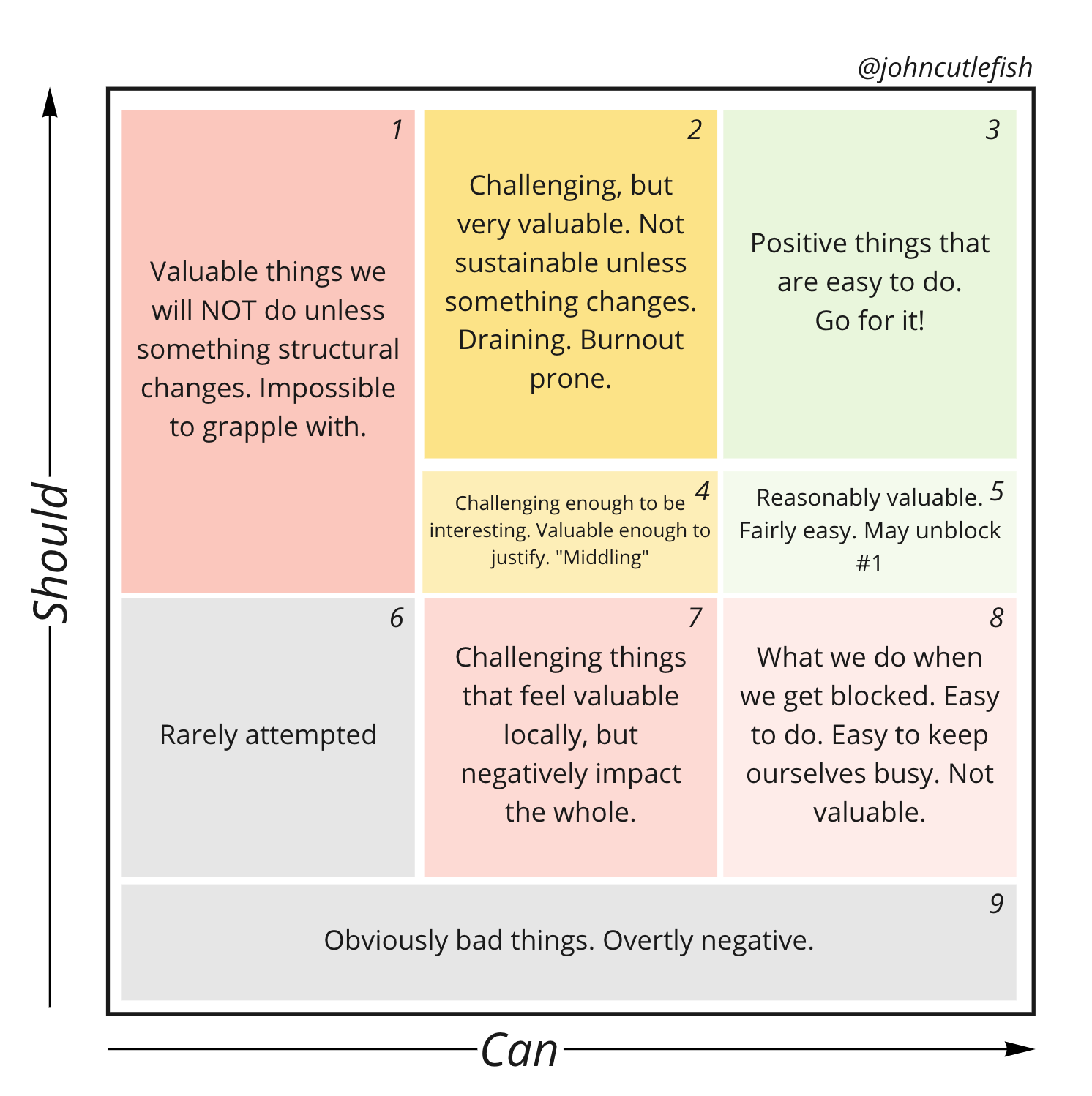
Meanwhile, you’re currently doing a lot of things you should either not be doing, should spend more time on, or should radically change your approach. The challenge is two-part: yes, you need to be considering the right or less wrong options, but it is also HOW you approach those things.
Exercise
Try this with your team. Fill in the blanks. If you can’t fill one in, skip it.
“We keep coming back to _______, but no one has a clear solution. And we seem unwilling to jump headlong into it. Every pre-mortem singles it out. Every quarter there are half-hearted efforts. But the threat is just abstract enough that there’s always a plausible story for why it might _______. We keep pushing it off to _______ and hoping that’s enough.”
“No one debates that _______ is important, and that is part of the problem. It’s fun. It feels productive. Saying yes is a well-worn habit. But unless we set limits, we’ll keep polishing it forever, well past the point of diminishing returns, while _______ starves. We’ve probably already captured _______% of the value.”
“Unless we agree to do _______ in principle, we’ll keep wasting time trying to prioritize each and every little piece of it. No single item is big enough to survive a prioritization meeting. But collectively? People should just be able to pull from this pile whenever _______. The value comes from doing it in _______, not batching it into some giant future initiative.”
“Everyone in the room knows something is off with _______. Confidence has dropped since _______. But the momentum is crazy. Ask a question, you get shot down. Nobody wants to be the person who held up the train. What we actually need to prioritize is permission to _______ it.”
“_______ has been almost done since _______. Everyone is tired of it. We keep giving it scraps of attention, and it keeps lingering. _______ stays blocked waiting on it. We need a short-lived period of extreme focus, or we need to stop pretending. That means explicitly saying _______ slows down for a bit.”
“We keep discussing _______ but never actually learn anything new. Someone is always ‘doing discovery’ on it amidst _______ other things, but nothing real emerges. We need to spend real, concentrated capacity resolving _______ before we can move.”
“_______ needs room to grow. We can’t judge it by the same standards as _______. We need to protect it and give the team leeway, but also hold them accountable for _______. The question isn’t ‘Is this paying off yet?’ It’s ‘Is this developing in a healthy direction?’”
“We keep calling _______ important, but no one will fund it, stop _______ for it, or hire against it. Is it important enough to displace _______? Important enough to add capacity for? Or neither? We either invest or say no.”
“What’s really stopping us on _______ isn’t the work itself. It’s the investment to be able to do it. We keep wishing we had _______, but we haven’t prioritized building that muscle. We have to prioritize our ability to do this, not just doing it.”
“The scope on _______ is huge. But there’s a credible path to radically less scope that still captures most of the value. What if we just did _______? There’s an 80/20 here if we’re willing to seriously test _______ before committing to the full thing.”
“_______ feels urgent because _______. But is that window actually real? What specifically changes if we wait until _______? Sometimes the answer validates the urgency. Sometimes it exposes something people just want to do now.”
“On paper, _______ looks like just another effort. But if you consider everything that would benefit, it’s critical. _______ gets faster. _______ gets cheaper. Unless you explicitly account for what it multiplies, it will always lose the prioritization conversation.”
Each one of these mad libs is designed to surface a tension, and a potential prioritization decision. Use them before you use whatever framework you had in mind to get the real questions and decisions on the table.
These are the real tensions to resolve.
I have been thinking about this a lot and I think it stems largely from orgs not baking the time for this kind of reflection. You also need someone internal who can facilitate and uncover those connections and that's even more unusual.
Also: strongly agree with your take that even though we try, we’re not really doing any kind of rational prioritisation.
Largely, we act based on short term expected emotional outcome. Discipline *looks* like it’s people overriding that, like the person who goes jogging every day, or publishes articles every week ;) but it’s secretly that such a person gets a short term positive expected emotional outcome from jogging or publishing. Sometimes they get it for “free”, sometimes they’ve trained themselves over months or years.
I think of that with teams too, and the frequent failed attempts to enforce “change everything” vs the relative success of shifting what kinds of things tend to feel good/easy to do vs bad/hard inside that system.