
TBM 434: How Maps Can Hide Problems

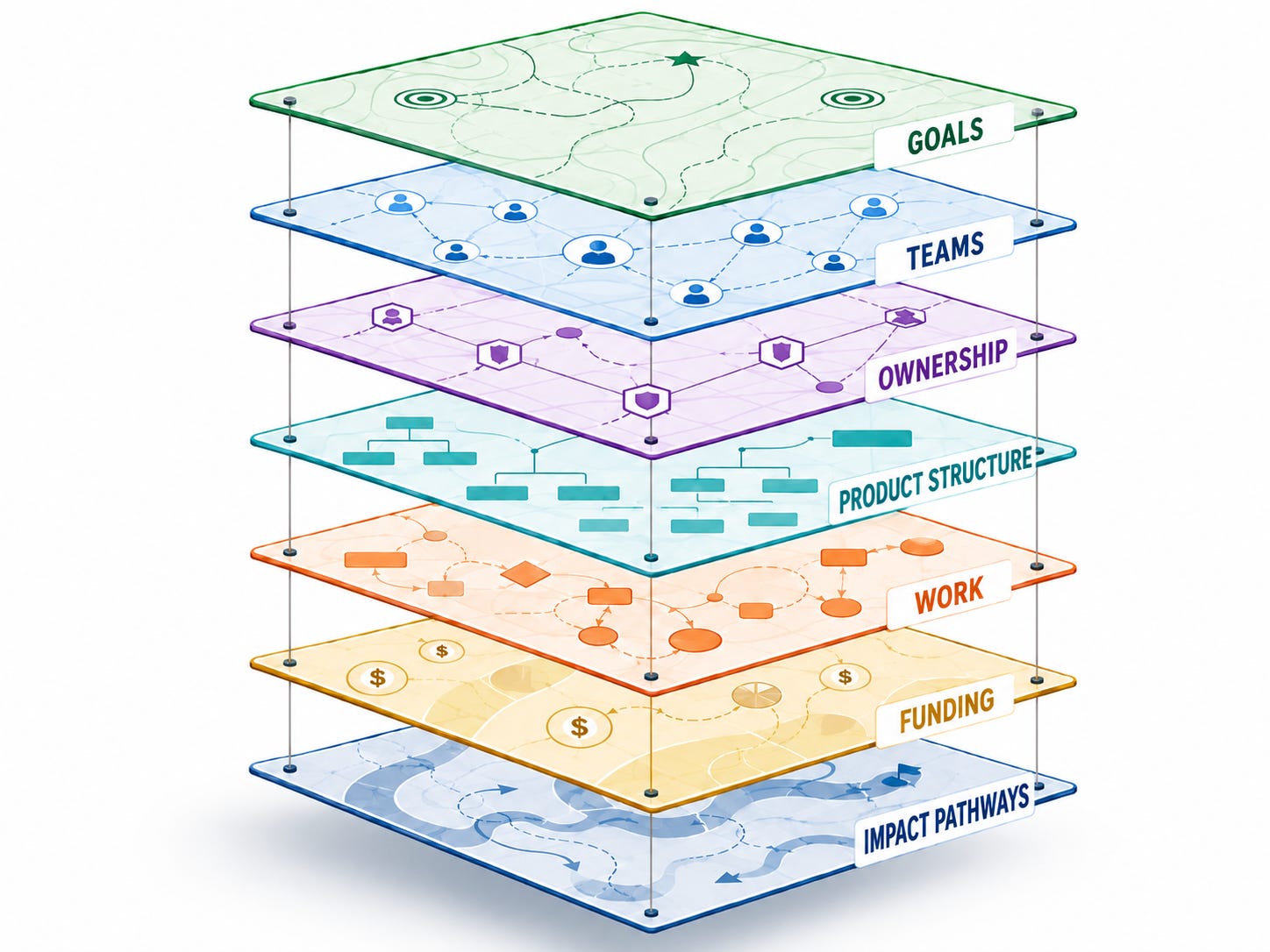
If what you are mapping is incoherent, don’t fall in love with the map (or your personal ability to navigate with it). Use it to refactor what you see.
Here’s why.
More Coherent Organizations
When strategy, structure, technology, and incentives are coherent, an organization can leave a great deal implicit. A team and its mission become reliable shorthand for its goals, ownership, work, funding, and intended path to impact. These are technically distinct structures. For example, work isn’t the same thing as goals, and teaming isn’t the same thing as a product taxonomy. But when they map cleanly to one another, there is little need to name every distinction, map every relationship, or maintain separate representations.
You can look at the teams or the goals and reliably fill in the blanks. There is tons of context, but there’s little need to spell it all out. In a coherent organization, what you learn from one map remains useful when you switch to another. In an incoherent organization, what you learn from one map may stop being useful the moment you switch to another. You have to reorient, translate, and fill in the blanks all over again.
Coherence lowers the energy required to make sense of what is going on—the “context.” For humans. And for humans using AI.
The best metaphor I can come up with is a city with several map layers.
The layers might show streets, utilities, public transportation, neighborhoods, zoning and land use, school districts, political jurisdictions, and so on. All of those things are different. But when the structures mostly line up, you don’t need to keep naming which map you are using. If you say “downtown,” people can infer transit access, building types, land use, population density, and patterns of activity. Imagine flipping through the layers in an online mapping tool: each layer shows different information, but the layers seem to line up. When you are out walking around, things make sense.
Back to organizations.
Less Coherent Organizations
Imagine something critical to the business that involves eight teams spanning eight different product hierarchies, all with competing goals; silos across product, technology, and design reporting lines; unclear ownership; theoretically distinct customer segments; different impact hierarchies; and different funding hypotheses.
Suddenly, you’ve lost your bearings.
A consultant friend described navigating an environment like this:
“I’d meet with a team and be completely blindsided by what they were getting into. I had to sit there and go through all of their work just to make sense of it. I found myself constantly surprised: ‘You’re doing what? Why? For who? Who made that call?’”
This is like a city where every map layer cuts across the others differently. The school district boundary runs straight through the middle of a neighborhood. The buses follow one set of corridors, while the trains and bike routes follow completely different ones. The place everyone calls “downtown” is split across two municipalities, three zoning districts, and several utility providers. The nearest fire station technically serves somewhere else. Parking permits, building codes, public services, political representation, and transit access all follow different boundaries.
This doesn’t mean some people don’t absolutely know their way around. They may feel perfectly at home, know which unofficial paths to take, and reliably get what they need done. Sometimes you can even pay people to help: expeditors, tour guides, brokers, fixers, or longtime locals who know which office to visit and whom to call. Individual neighborhoods can also feel perfectly coherent, at least until you need to cross a boundary to get something done. But the fact that insiders can navigate a place does not make the place coherent. It may simply mean that navigation has become a specialized skill.
And this is the big puzzle.
A company can become extremely sophisticated at documenting dependencies, translating between groups, creating cross-functional forums, hiring fixers, and building tools that help everyone navigate the incoherence. Those things may be necessary. But they can also lower the immediate pain enough that the underlying incoherence never gets addressed.
AI will not magically make context coherent. It can surface and compare the maps, and maybe even call out incoherence, but it cannot make conflicting structures, incentives, goals, and definitions line up. In fact, when it smooths over those contradictions, it may exacerbate the underlying tensions while producing the appearance of alignment.
The goal is not perfect coherence. Perfect coherence would likely require either stasis or an organization so tightly constrained that it could not adapt. The goal is to notice where the maps have stopped lining up, decide which gaps matter, and continually bring the most consequential ones back into alignment.
If what you are mapping is incoherent, don’t fall in love with the map. Use it to refactor what you see.
"If what you are mapping is incoherent, don’t fall in love with the map"
John, this feels like a very important reminder for those who pride themselves in playing leadership roles when it comes to mapping and building coherence. It connects well to your point later in this essay around not seeking perfect coherence, at the risk of reinforcing a map that can not change.
I have been thinking a lot about AI context management these days, and came to a similar conclusion recently. More coherent organizations tend to have less explicit, legible context - because they don't need it. This can be in stark contrast to less coherent orgs that may be swimming in strategy, decision, alignment, operational, etc. artifacts that are borne out of necessity. In some sense, both types of orgs have "blind spots" when it comes to how they might equip their AI systems with context.