
TBM 433: The Border Collie Faustian Bargain

(I have a question at the end, if you get there)
Picture a company annual kickoff.
Leaders are sharing a strategy that is objectively not a strategy. Not just by a purist’s standards, but assume for a moment that the experienced people in the room all know it isn’t a strategy.
So we have:
Believers
The less experienced people in the room who are happy that someone seems to have a plan. They’re not skilled enough to know what a strategy is. If it sounds somewhat coherent to them, they’ll be excited.
Players
The experienced people in the room who know it isn’t a strategy, but also know the “game” behind the real strategy. They know that the annual kickoff is a performance. They know how to play the funding game. They know where the “real” conversations happen, and the spreadsheets where those conversations get codified. But they also know when to nod, when to smile, how to nail their slide, and generally keep the show going.
We can probably split these folks into the hard-core Dark Triad people, the “you just don’t understand how hard leadership is” crowd, the “some things we just can’t say out loud because it would demotivate them” contingent, and the “savvy operators who know how to get stuff done, know this doesn’t matter, and are pretty decent people” crew.
Oh, and the “if we focus, people will phone it in, so our strategy should be ambitious and we should try to do everything” crowd. But that’s a post for another day.
Checked Out
Next, you have the people who have checked out of these types of meetings. They do great work, but they’ve learned that somehow nothing discussed in these meetings really matters, unless it does, at which point their ears immediately perk up. For example, if there’s a shift around RTO.
For the most part, the meeting sounds like “blah blah blah” white noise to them.
Purists
Then you have the purists who seethe about it not being a strategy.
“This is bullshit!” they say.
“This is a bad strategy! I read the book!”
“These people are incompetent, self-serving, or both!”
Confused Coherence Checkers
And then you have the folks who are genuinely confused. They aren’t naive like the purists. They know this is a bit of a show. But they are sitting there wondering if they somehow didn’t get the memo.
Given everything at stake, why NOT put a real strategy up there? Even if it were a bit watered down?
“Am I a chump for not playing the game the #2s are playing?”
“I mean, surely they don’t believe this is a strategy. Or do they?”
They feel tempted to raise their hand and ask a question, but immediately sense that might be a bad idea.
“This is a $150,000 meeting,” they wonder. “Am I missing something?”
They feel for the teams that are going to bear the brunt of the ambiguity. They aren’t just noticing that the strategy is incoherent. They are already imagining the meetings that will follow, the conflicting interpretations teams will make, the work that will continue despite the supposed priorities, and the people who may later be blamed for failing to execute.
“I feel that, with just a bit more work, we could have turned that into a great presentation!”
The last time they said that out loud, they were told to be more of a team player. They are also trying to calculate whether saying any of this now would help, embarrass someone, derail the meeting, damage their standing, or simply mark them as difficult.
They know that every presentation leaves things out. They know leaders cannot explain every constraint, tradeoff, political reality, or unresolved disagreement to the entire company. They are not asking for perfect transparency. What bothers them is that the gap between the presentation and reality feels large enough to change what people will do.
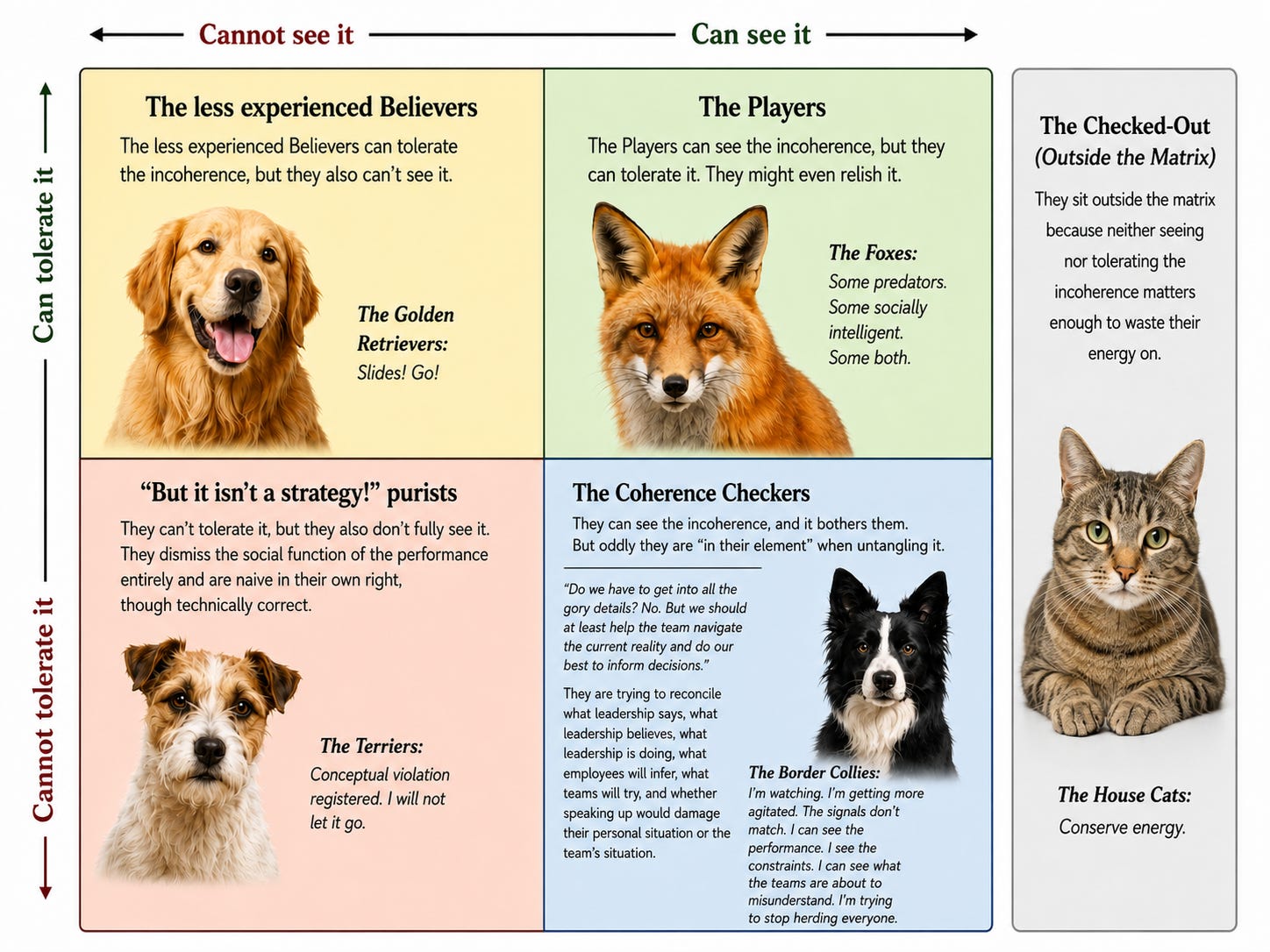
2x2: See It, Tolerate It
Imagine a 2x2.
Cannot see it, Can see it
Can tolerate it, Cannot tolerate it
The less experienced Believers can tolerate the incoherence, but they also can’t see it.
The Players can see the incoherence, but they can tolerate it. They might even relish it.
The Coherence Checkers can see the incoherence, and it bothers them. But oddly they are “in their element” when untangling it.
“Do we have to get into all the gory details? No. But we should at least help the team navigate the current reality and do our best to inform decisions.”
They are trying to reconcile what leadership says, what leadership believes, what leadership is doing, what employees will infer, what teams will try, and whether speaking up would damage their personal situation or the team’s situation.
The “But it isn’t a strategy!” purists can’t tolerate it, but they also don’t fully see it. They dismiss the social function of the performance entirely and are naive in their own right, though technically correct.
The checked-out people sit outside the matrix. They have figured out that neither seeing nor tolerating it matters enough to waste their energy on.
If these were animals, you’d have:
The Golden Retrievers: Slides! Go!
The Foxes: Some predators. Some socially intelligent. Some both.
The House Cats: Conserve energy.
The Terriers: Conceptual violation registered. I will not let it go.
The Border Collies: I’m watching. I’m getting more agitated. The signals don’t match. I can see the people. I can see the performance. I see the constraints. I can see what the teams are about to misunderstand. I’m trying to stop herding everyone.
The Border Collie Faustian Bargain
It is a Faustian bargain of sorts for the Border Collies.
You can become a Fox, and maybe have more impact, if you surrender your right to challenge the fiction. But you risk, over time, becoming responsible for persuading everyone else that it is true.
You stop asking whether the ambiguity is helping the organization and start treating its preservation as part of your job.
At first, you rewrite the confusing message for your team.
Later, you explain why leadership had no choice but to make it confusing.
Eventually, you find yourself correcting the person who points out that it is confusing.
The bargain rarely presents itself as, “Sell your soul.”
It is more like:
“Be realistic.”
“Don’t undermine the team.”
“You’ll understand when you’re more senior.”
“Get some influence first, then you can change things.”
The system teaches people that being “responsible” means protecting your boss, avoiding visible failure, keeping your options open, toeing the line, and making difficult outcomes and decisions appear impersonal.
The risk?
You begin producing the conditions you originally hoped to navigate. You tell yourself you are staying close to power so you can make things better, but your job gradually becomes about protecting the ambiguity, conveying it downward, and disciplining the people who point it out.
You become a Trapped Fox. You say, “I’m done with this place,” and then stay for six more years.
Or you become a Nomadic Fox, moving from company to company, arriving with fanfare and a reputation as a fixer or seasoned operator. With a flick of the tail, they locate the real decision-makers, learn the game, build a coalition, and become indispensable.
Enter as an outsider.
Decode the system.
Become indispensable.
Hit the limits of influence.
Decide the organization is hopeless.
Leave for a new, more interesting puzzle.
Back to the Border Collies
Back to the Border Collies, assuming they haven’t gone the Fox route (yet).
Of all the players, they are carrying the most in their heads.
Do you bark and name the contradiction in the room?
Backchannel it to someone who may actually have the influence to change something?
Herd locally by translating the ambiguity into something your team can use?
Leave the field after deciding that the organization’s coherence is no longer your responsibility?
Or conserve energy like a cat?
The Question:
What advice do you give Border Collies?
Comments appreciated!
I think it depends on what they’re aiming for.
If their goal is to drive change inside a company, then they have to learn to play office politics and pretend to be each of those five species when needed.
If their goal is to move into a different quadrant, then I’d probably reduce the importance they assign to work and limit the exposure to the rooms where decisions get made. On the one hand, they see fewer imperfections; on the other, they spend less time obsessing over them.
If their goal is simply to be happy at work… then this is probably my most genuine piece of advice: make peace with the idea that work will never fully provide that, because that’s not what work is for. I’ve been thinking about this a lot lately. Maybe it’s just resentment talking, but I increasingly feel that millennials were sold this idea that the job should be an extension of yourself, a core part of your identity. I’m no longer convinced that’s the only, or even the healthiest way to think about it.
Having learned the term a while ago, I’m sitting again with the term “overfunctioning” as I think - with great support and compassion - about your border collies. Most especially about their internal talk track to stop trying to herd everyone. Because perhaps the herd will always need herding - at least by degrees - and perhaps herding is precisely what they are encoded to do. If so - and regardless, from a place of care - my advice to collies is to make sure they’re taking care of themselves, resting when they can, fuelling themselves healthfully, because their job is an endurance sport, and they’re going to be running, again, tomorrow …
Beyond that, I’d offer up Honey Dacanay and her in-development Field Guide to (better) represent answers: https://honeydacanay.ca/field-guide.html.
Cheers for another thoughtful and provocative post, John. That one hit rather hard.