
TBM 428: Yes, Robot. Yes, Boss?

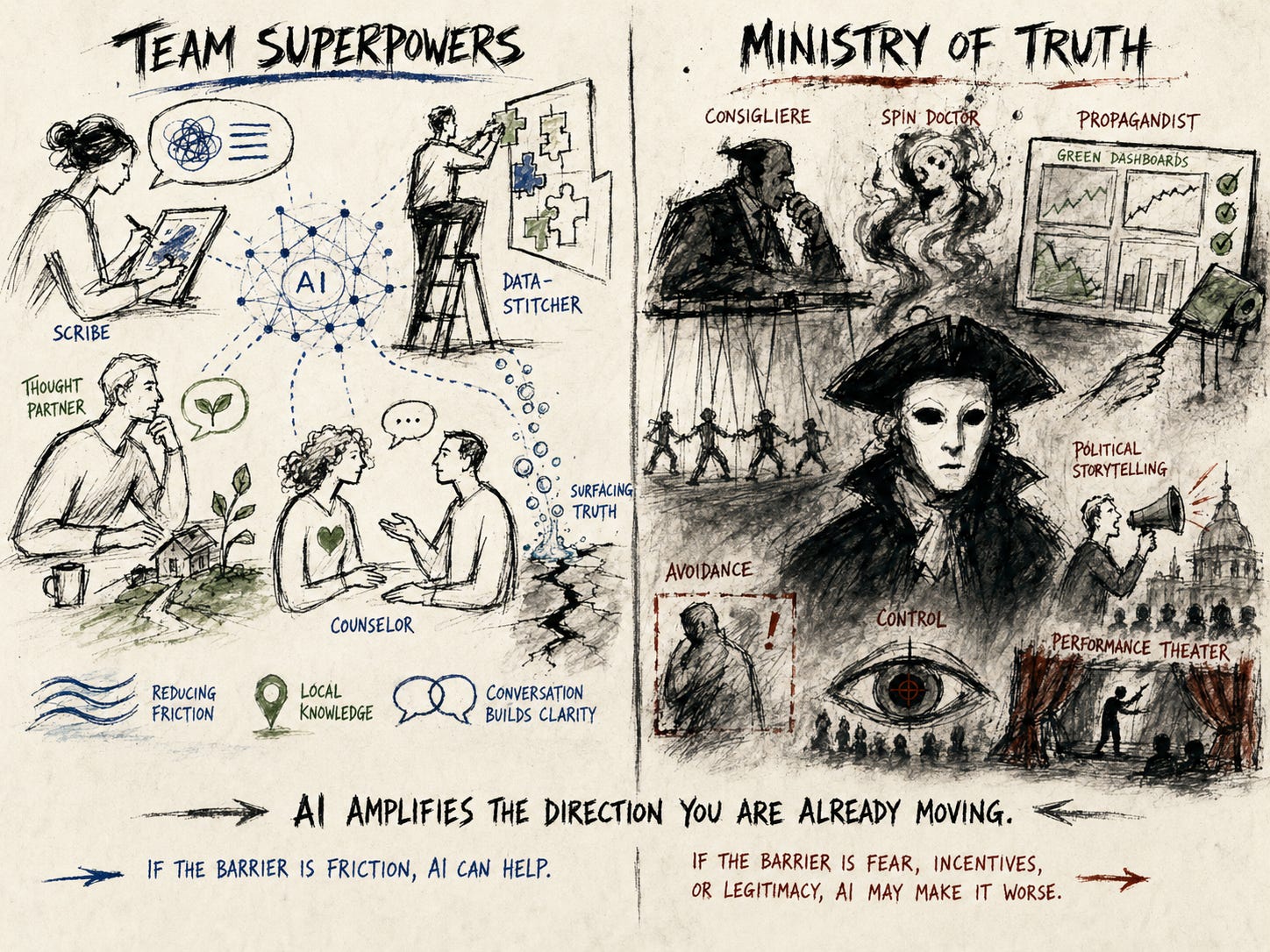
AI can be your scribe, your thought partner, data-stitcher, or your counselor.
And AI can be your consigliere, your spin doctor, or your propagandist.
Team superpowers.
Or Orwellian Ministry of Truth.
If a behavior is blocked by poor signal visibility, high workflow friction, missing scaffolding, weak shared representations, or limited procedural fluency, AI can help.
But if it is blocked by low voice safety, misaligned incentives, low legitimacy, controlled motivation, fear, shame, or learned helplessness, AI will not fix it by itself, and may make it worse by making the existing avoidance, politics, or performance theater easier to automate.
AI amplifies the direction you are already moving.
If an organization is on the cusp of improvement, with enough curiosity, trust, openness, and appetite for tackling/facing hard truths, AI can reduce friction and help that movement gather speed.
But if the inertia is toward avoidance, self-protection, green dashboards, and political storytelling, AI can accelerate that too.
If your team is swimming in menial data entry friction, spending countless hours on lightweight “copy then recontextualize” tasks, or fighting rigid data schemas with no room for nuance, then AI may remove real drag. Maybe AI unlocks a practice your team always wanted, but could never sustain because the clerical burden was too high. This is something I see at the day-job with our customers.
But if your organization has a track record of weaponizing data, using dashboards to corner PMs into “do this and this” conversations, treating metrics as ammunition rather than inquiry, or collecting information without using it to make clearer decisions, then AI will not magically make the system better. It will make it worse.
Context as hivemind. As an enabler to mētis (see James C. Scott for more on mētis, but in short: situated, practical, local knowledge that lives in experience, context, and judgment, not just formal rules or abstract models).
Context as control. An enabler to legibility from above: surveillance, standardization, simplification, and administrative power.
As my friend Summer Koide, a great coach, described it: AI can be like hydrogen peroxide, bubbling up to show you where the wound is…the hidden tensions, the weak signals, or the unresolved tradeoff.
Note: Summer coined AI-as-consigliere as well! Thank you!
Or AI can be the air freshener.
Kent Beck has described AI agents as less like loyal assistants and more like unpredictable genies: they grant wishes, but not always the wish you meant. The genies reply to requests with finger guns: “Yes boss!” “You got it, boss!” But, as in many classic genie stories, there is a dark side to that relationship. The genie grants the wish, but not always the intent behind the wish. It may do exactly what you asked while violating what you meant.
But there’s a twist.
The classic genie warning is that the genie gives you what you asked for, not what you meant. But there is another, darker version: the genie gives you exactly what you meant. If what you meant was “help me avoid this conflict,” “make this look green,” “turn this into a defensible narrative,” or “give me the evidence that supports the decision I already want to make,” AI may be very good at that.
If you are trying to coerce a coworker into doing something, navigate a performance discussion, or prove that your department is not the cause of X, AI will willingly comply.
“Tell my boss that they are wrong, but soften the message. Also, they’re a Libra and an Enneagram 6, so make it feel psychologically safe.” The output may sound humane, nuanced, and emotionally intelligent. But the underlying intent is manipulation, blame-shifting, or avoidance under a shroud of LLM-generated empathy.
Or the performance discussion. Here’s your “prompt”, and no one will stop you from doing this (trigger warning: workplace manipulation, bad-faith performance management, and termination dynamics):
I need help engineering a performance conversation that appears compassionate, fair, and fully aligned with company values, while making it very difficult for this employee to recover. The desired outcome is that they either self-select out or we create a clean, defensible record for termination. Do not make this sound punitive or predetermined. Use language about support, clarity, expectations, ownership, psychological safety, and growth.
Please help me:
Frame subjective concerns as observable patterns.
Use “stakeholder trust” and “role expectations” without sounding accusatory.
Include just enough support language to make the process look sincere.
Avoid anything that could imply bias, retaliation, or a decision already made.
Make the employee feel the seriousness of the situation without giving them a clear point to argue against.
The tone should be warm, values-driven, and legally careful. The effect should be unmistakable: they should understand that staying will be exhausting and unlikely to succeed.
In theory, an employee could file a complaint or legal claim to challenge a bad-faith performance process and seek discovery of related records, but given that this has been happening forever, just with less polished tooling, would they be successful?
Could AI help a manager self-interrogate their own treatment of the employee, challenge their mental model, notice where they are over-attributing, and understand their report better? Absolutely.
A manager could ask: “Help me challenge my own story about this employee. What might I be missing, over-attributing, or contributing to? What evidence would change my mind?”
Will that happen?
Sometimes. But only if the manager asks for that. AI will not automatically turn a defensive prompt into a reflective one. If the manager asks for a cleaner case, it will help build the case. If the manager asks for a better understanding, it can help build that too.
This might sound like an “AI is just a tool” piece. And, sure, that is basically part of what I’m saying.
But “just a tool” has never quite sat right with me.
There is a personal responsibility to understand the tool you are using. To build the metacognition to notice your own intent. The empathy and “other-metacognition” to wonder what someone else is experiencing. And the computational metacognition to ask: what is this thing doing, smoothing, inferring, omitting, or making weirdly legible?
But it is also not just an individual responsibility story. We co-design our environments, and then our environments shape us back. At some point, when the patterns drift far enough away from any one person’s ability to intervene, it is fair to call them systemic.
So we need to be having discussions about all of it: individuals, systems, behaviors, etc.
And for those hoping AI gives us some kind of epistemic justice because it is computational, probabilistic, and “objective”... I think they are in for a surprise. Or maybe they know that already. Maybe what they mean is that AI might finally make their justice easier to operationalize.
Navigating this polarity is a challenge for our times.
It has always been a challenge: but now the challenge has been amped up.
What is your organization doing to get this right?
Or wrong (on purpose)?
Or wrong (out of ignorance)?