

TBM 37/53: Talk to Your Manager, Take the Survey
TBM 37/53: Talk to Your Manager, Take the Survey

Talk to your manager...
"Take an engagement survey..."
In most organizations, this is how feedback reaches the top. And why it doesn't (or at least some of it doesn't).
Most of the time this OK. Feedback is local, and action is local. Your team works it out and solves the problem. But sometimes the problem is less local. Information needs to travel further for it to make a difference.
In this situation, people are quick to blame managers for over-filtering and/or failing to coordinate a response. "Of course my manager didn't share that! It would make them look back," says the team contributor. "How am I supposed to do anything if managers don't share the specific problem?" says the CEO. "Why didn't X reach out so we could work this out?" says the peer manager.
But managers are often not the source of the problem. Less local challenges tend to be more complex. One perspective will not suffice. Much of our work in product development (and software product companies) spans functions. Even if we're not on an official cross-functional team, we likely collaborate across departments. Which all means that asking individual managers to take this on is a bit of a stretch. Even with the best intentions, they'll apply their own biases and filter the information.
Enter the engagement survey. In theory, engagement surveys leapfrog management and take the temperature of the organization. But there are issues. How representative is the feedback? Employees have very different motivation levels when it comes to providing in-depth feedback. Some people are nervous about being transparent. Some people have checked-out (check response rates). There's recency bias depending on whatever has happened in the last couple weeks. It's hard to detect weak signals, and the feedback often covers known issues...not new, emergent challenges. Finally, only rarely do the surveys ask whether people have any confidence that their feedback will be acted on.
This is why I am a big fan of a large(r)-scale retrospectives and continuous improvement events. They are effective at surfacing key issues and narratives spanning functions and departments. And do so -- in my experience -- at far more depth than typical surveys and even 1:1s.
While the group may be small -- a group of managers, or a small department -- you can also do this with lots of people. 350 people! This is a great overview of a large-scale event for over three hundred people (written by my good friend Heidi).
Another good source for ideas is the Liberating Structures community.
This topic is very much on my mind lately as companies grapple with being newly remote. Sadly, I'm observing companies drift further and further into siloed communication and over-reliance on "normal" feedback mechanisms . This makes sense, because it is easier while remote, but it is also potentially very harmful in the long run.
The risk is that this dynamic crops up:
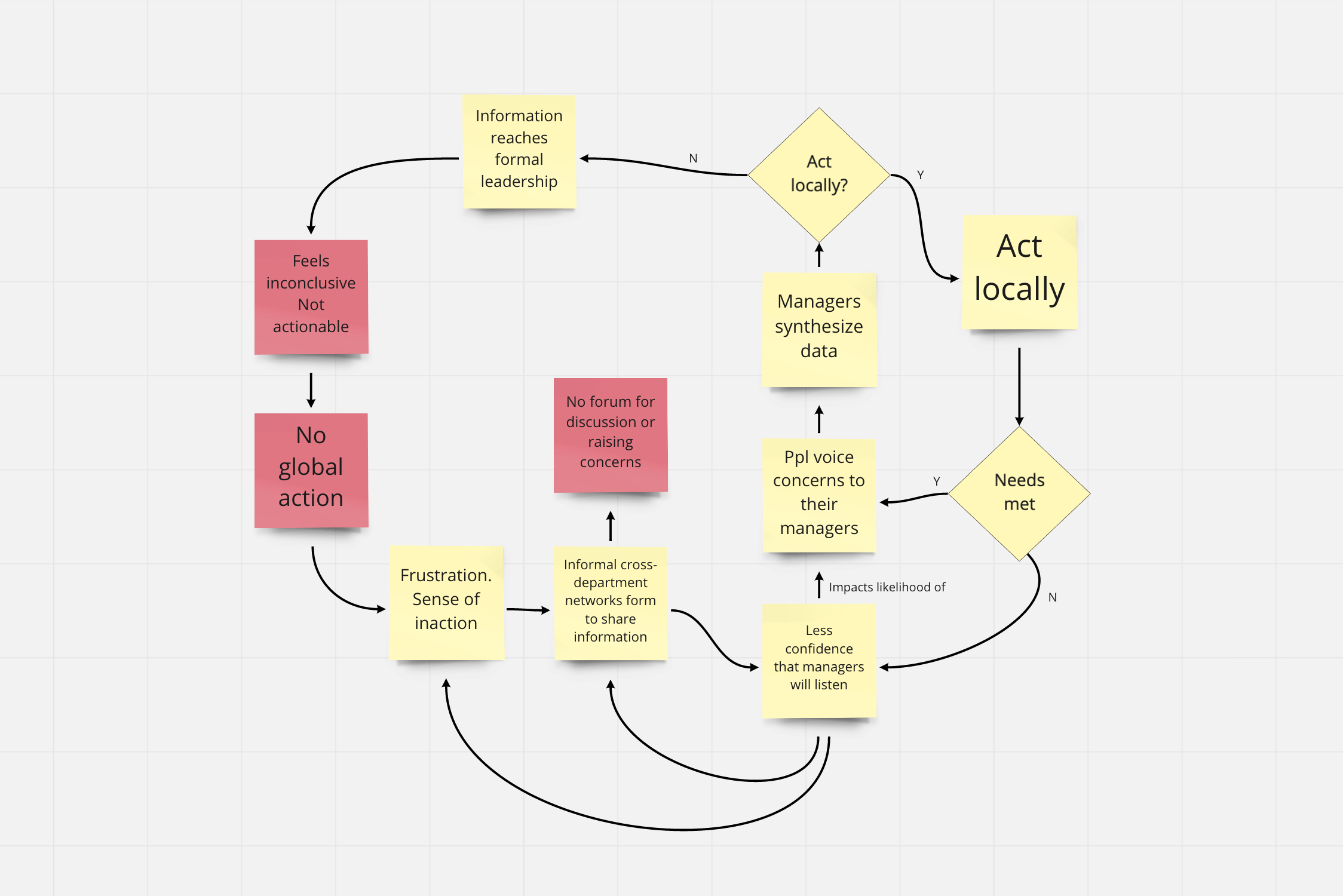
…which is not what we want to see happen.
Engagement surveys are becoming imho a classic example of intervention with a high efficiency (answers collected compared to time spent in creating and sending the surveys) and a low effectiveness (what desired outcomes in the engagement area are you actually able to achieve by using those outputs?)
The large scale events (e.g. with all the 300 people in the org) that you are mentioning, in which conversations are encouraged and key insights and narratives emerge - might be in the opposite side for most organizations: low efficiency (perceived), high effectiveness (uncertain).
The distributed setup makes the perceived efficiency even lower - ”300 people in the same virtual room and you expect this to inspire conversations?? It will probably be a waste of time for all, instead” while the effectiveness of the action is way more uncertain - ”who else has done this and with what results?”
Also, you can add to this prudent view of large scale events the lack of professional facilitators (that have the experience and expertize to run such events). Facilitating large scale virtual events? Probably less than 100 skilled facilitators worldwide.
I'm curious if other readers have found viable alternatives to engagement surveys and "pulse" surveys.
Thanks,
Bülent Duagi