
AI Won’t Save the Kingdoms We Built

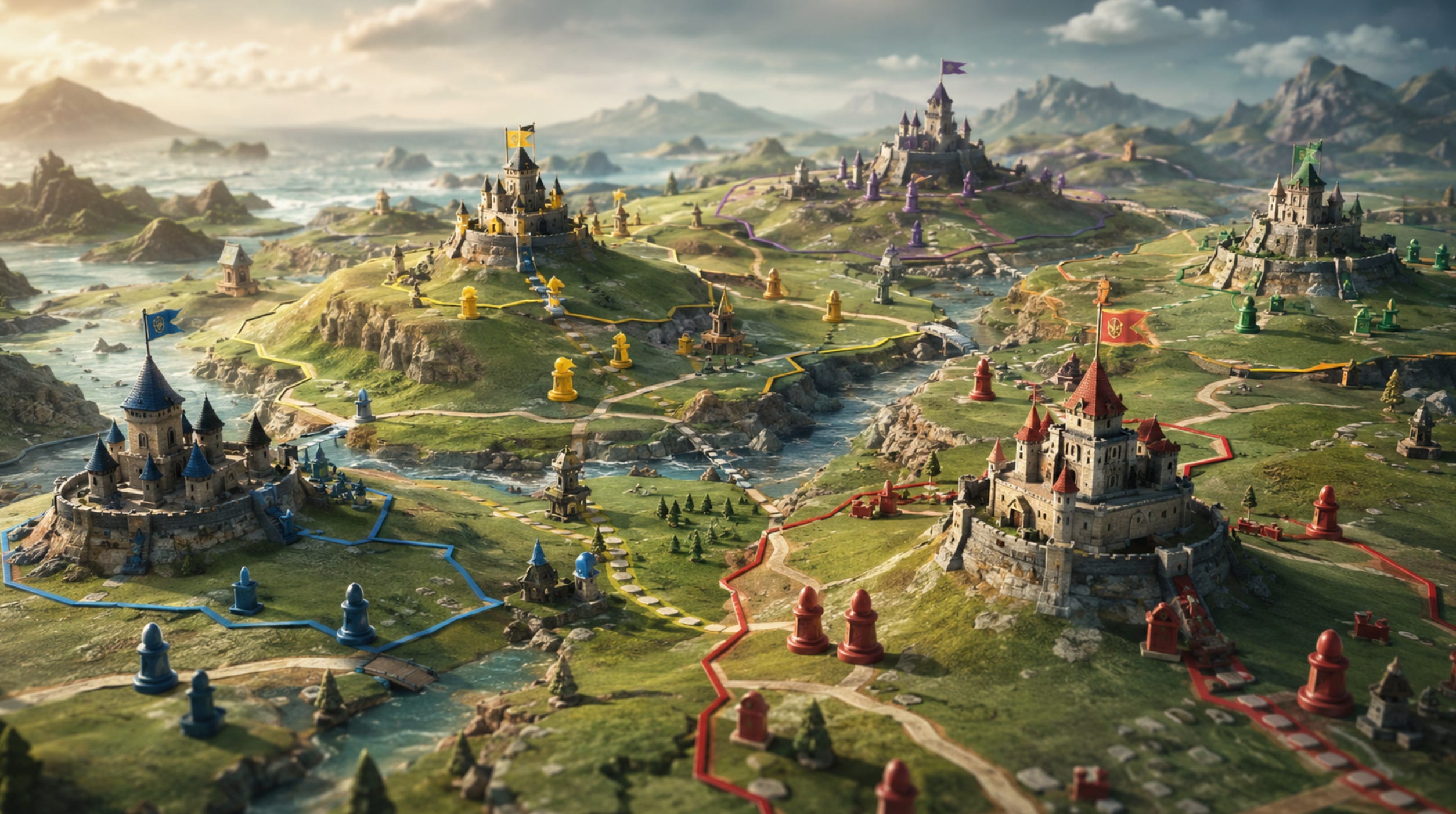
This post is about the people who built the fiefdoms now looking to AI to save them from the fiefdoms, and why that will only work if we are honest about what those fiefdoms were built to avoid in the first place.
Unfiltered Saturday morning coffee writing engaged.
The people who built the fiefdoms are now complaining about the fiefdoms That is the part I can’t stop thinking about.
Some of the same people who benefited from riding the ZIRP wave to safer places of leadership are now waxing, not very poetically, about flattening orgs, 10x engineers, getting into the details, reducing bureaucracy, and getting closer to the work. The people who helped build the system are now turning around and saying the system is out of control.
And to be fair, the system is (and was) out of control.
But it did not come out of nowhere. The GM fiefdom model was built on assumptions that, at the time, probably felt reasonable. The first assumption was that autonomy creates speed. If you give a leader a clear area, a team, a budget, and a mandate, they can move faster than if every decision needs to be negotiated across the whole company. The second assumption was that business accountability creates focus. If a leader owns the outcome, and not just the work, they will make better tradeoffs. They will act more like a general manager than a functional lead.
The geometric problem
The third assumption was that as an organization gets larger, you need people “at the head” of these things. You need leaders who can absorb complexity, make calls, and keep the system from collapsing under the weight of everyone needing to talk to everyone else. It was a geometric problem. And on some level, I think there was an intuitive appreciation for Dunbar’s number. People knew there were limits to how many people could collaborate closely, how much context people could hold, and how much coordination a group could tolerate before everything slowed down.
So the answer became: create smaller worlds, give each world a leader, give each leader accountability, and let them run their business. That is the GM mindset. And in the ZIRP era, you saw a lot of it. You saw business-minded product leaders grow by adding more and more “products.” You saw more layers, more sub-orgs, more areas, more heads of things. You saw “product” become a container for almost any sufficiently large bundle of work, even when the thing being called a product was not really a product in any meaningful end-to-end sense.
The pain was always there
Anyone working in those environments felt the problem viscerally.
Dependencies compounded. The end-to-end experience became harder to reason about. Things that were supposedly separate turned out to be deeply connected. One team’s work created a blast radius for another team. The customer did not experience the org chart as cleanly as the org chart experienced itself.
People would say, “We need to focus on the end-to-end experience.” Other people would say, “That’s too hard.” And in a way, they were right. It was too hard, given the structure. It was too hard because senior leadership was unwilling to prioritize across fiefdoms. It was too hard because the leaders inside those fiefdoms had self-interest. It was too hard because the system had created local accountability without enough shared responsibility for the whole.
So the company kept barreling forward in ways that continued to perpetuate the problem. The coordination burden moved downward. The people closest to the work were left to discover the dependencies, negotiate the exceptions, route around the politics, and absorb the ambiguity. After a while, once they realized no one was going to resolve the underlying structure, they resigned themselves to functioning the best they could.
Now enter AI
Suddenly, AI appears to offer a way out. What if we did not need all of those fiefdoms? What if smaller teams could get more done? What if AI could act as the coordinator, the aligner, the context-transferer? What if more people could “work together” without actually needing to work together in the old way?
There is something real there. AI can reduce information friction. It can summarize. It can retrieve context. It can help people see patterns. It can surface dependencies earlier. It can make smaller teams more capable. It can lower the cost of keeping context moving across a flatter organization.
But context transfer is not the same thing as shared understanding. AI does not clarify who decides. AI does not neutralize incentive misalignment. AI does not resolve contested ownership. AI does not create the slack needed to coordinate well. AI does not magically fix the political economy that made the fiefdoms feel untenable while allowing them to persist anyway.
The real opportunity
The opportunity is not “AI lets us pretend we do not need to choose.” The opportunity is that maybe, finally, we make the hard organizational choices that should have been made anyway: clearer end-to-end ownership, decision rights that match responsibility, senior leaders willing to prioritize tradeoffs, and smaller teams with enough autonomy to move without recreating the old mess.
In that world, AI is genuinely useful. It becomes a cheap context layer. It helps teams see dependencies. It helps leaders spot conflicts earlier. It helps the front lines avoid carrying the full coordination tax alone. But that only works if the organization has done the real work. AI can amplify a coherent operating model. It cannot substitute for one.
The new coordination theater
What gets in the way of that opportunity?
AI can create a new kind of coordination theater: the appearance of working together without the friction of actually deciding together. This is why I care more about meetings and collaboration now than I ever have before.
People with a bias toward working alone suddenly have a whole new quiver of tactics to avoid working with other people. They set up agents. They send copious documentation. Their agents talk to your agents. They shut down conversations with hastily pulled-together, but very persuasive, deflectors. I am not saying this is intentional or malicious. But if you are tuned in a certain direction, AI can accentuate that tuning.
If someone was already allergic to “groupthink,” and they now exist in a world where agents do their bidding, then the future is now. Meanwhile, people who see value in collaboration are overloaded trying to handle the overflow of decision-making, noise, and responses to all of these async tactics. They are desperate to be thoughtful while dealing with a deluge of theoretically replaceable moments.
The old problem in a new shape
There is potential for way more WIP, and people only have marginal control over it, though they imagine their agent-form does. It sits in their mind, eating away at focus. So yes, AI can help us move beyond the fiefdom model, but it can also recreate the same problem in a new shape. The old coordination burden was pushed to the front lines by org design. The new coordination burden may be pushed to the front lines by async abundance.
Good collaboration can save millions of dollars of wasted effort. It can be one of the highest-leverage things you do. But AI will not automatically make us better collaborators. It will not automatically make us flatter, clearer, or more coherent. Like a lot of things, AI can supercharge existing habits. It can supercharge avoidance. It can supercharge fiefdom-preservation with better prose. It can supercharge solo-optimized work at scale. Or it can supercharge adaptation to the new reality, but only if we are honest about what the problem was in the first place.
Great provocations.